
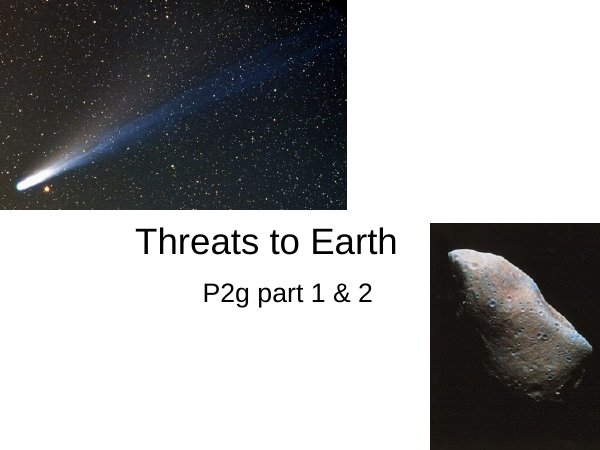
A two part GCSE physics lesson on threats to Earth from space. It covers what asteroids are, why the asteroid belt lies between Mars and Jupiter, evidence of past collisions with Earth, and comets such as Halley and Hale-Bopp, with gap fill questions and answers. Includes Foundation and Higher outcomes.
What this presentation covers
- Asteroids and the asteroid belt
- past collisions with Earth
- comets including Halley and Hale-Bopp
- how asteroids and comets are observed
Level: GCSE (Foundation and Higher)
Slides: 21
Format: PowerPoint (.ppt)
Teaching notes
How to use it. A GCSE Physics lesson with Foundation and Higher outcomes, and the gap fill questions make a ready made plenary. Pupils enjoy the evidence for past collisions, so a photograph of a large crater is a good hook. A useful extension is to ask what could be done if an asteroid were found heading towards Earth.
Key words
- Asteroid: a rocky object that orbits the Sun, too small to be a planet
- Asteroid belt: the region between Mars and Jupiter where most asteroids are found
- Comet: a lump of ice, dust and rock that orbits the Sun
- Meteorite: a piece of rock from space that survives falling to the ground
- Crater: a bowl shaped hollow made when an object hits a surface
Quick check questions
- Where is the asteroid belt?
- What are comets made of?
- How often can Halley’s Comet be seen from Earth?
Show answers
- Between the orbits of Mars and Jupiter.
- Ice, dust and rock, which is why they are sometimes called dirty snowballs.
- About every 76 years. It is next due in 2061.
Related lessons: Meteors and Meteor Showers | Deep Impact Comet Mission | Jupiter