
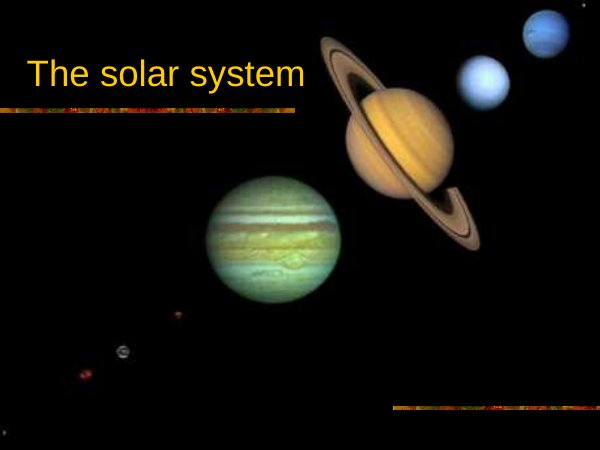
A simple, clear explanation of the Solar System. It defines the Solar System, lists the planets in order from the Sun, explains how gravity keeps planets in their orbits, and introduces moons as natural satellites.
What this presentation covers
- What the Solar System is
- the planets in order
- how planets orbit
- gravity
- what moons are
Level: KS2 / KS3
Slides: 12
Format: PowerPoint (.ppt)
Teaching notes
How to use it. A short, clear lesson for KS2 Earth and space or early KS3. It is ideal as a starter before a longer topic. A memory sentence helps pupils learn the planet order: My Very Easy Method Just Speeds Up Naming (Mercury, Venus, Earth, Mars, Jupiter, Saturn, Uranus, Neptune). A scale model on the school field, using a football for the Sun, shows how far apart the planets really are.
Key words
- Solar System: the Sun and everything that orbits it
- Planet: a large, round body that orbits a star and has cleared its path of other objects
- Orbit: the curved path one object takes around another
- Gravity: the force of attraction between objects with mass
- Moon: a natural satellite that orbits a planet
Common misconception: “Planets orbit because they are pushed round by something.” Nothing pushes them. Each planet is moving sideways very fast, and the Sun’s gravity keeps pulling it inwards, so it keeps curving round in an orbit.
Quick check questions
- Which planet is closest to the Sun?
- What keeps the planets in orbit around the Sun?
- What is a moon?
Show answers
- Mercury.
- The Sun’s gravity.
- A natural satellite that orbits a planet.
Related lessons: The Sun and Solar System | The Moon | Gravity on Planets
New free lessons every week.Follow World of Teaching on Facebook so you never miss one.Follow on Facebook