
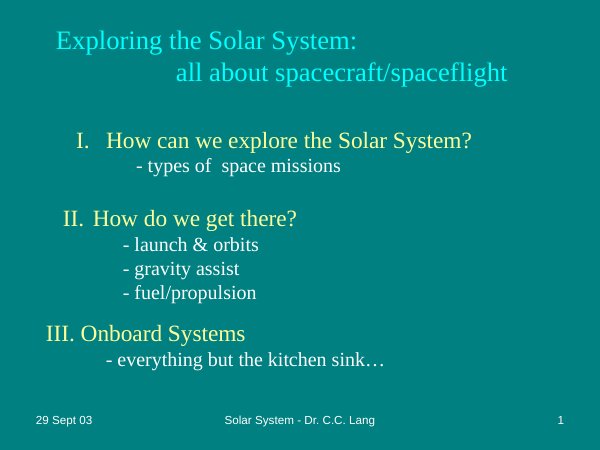
A detailed lecture presentation on how we explore the Solar System. It covers the main types of space mission, from flybys to orbiters and landers, how spacecraft are launched and placed into orbit, how gravity assist works, propulsion and fuel, and the onboard systems a spacecraft needs. Voyager 2 is used as a worked example. Lecture notes by Dr C. C. Lang.
What this presentation covers
- Launch and orbits
- gravity assist
- fuel and propulsion
- flyby, orbiter and lander missions
- Voyager 2
- onboard spacecraft systems
Level: A Level / University
Slides: 30
Format: PowerPoint (.ppt)
Teaching notes
How to use it. These lecture slides are pitched at A level and first year university, so they suit physics students or a sixth form astronomy club. Voyager 2 runs through the slides as a worked example, so it helps to show its route through the outer planets on a diagram first. A good task is to plan a simple mission to a chosen planet, deciding whether it should be a flyby, orbiter or lander.
Key words
- Flyby: a mission that passes a planet without stopping or going into orbit
- Orbiter: a spacecraft that goes into orbit around a planet to study it over time
- Lander: a spacecraft that touches down on the surface
- Gravity assist: using a planet’s gravity to change a spacecraft’s speed and direction
- Launch window: the period when the planets are lined up to make a journey possible with the least fuel
Quick check questions
- What is the difference between a flyby and an orbiter?
- Which planets did Voyager 2 visit?
- Why do missions have to launch within a launch window?
Show answers
- A flyby passes the planet once; an orbiter goes into orbit and studies it over a long time.
- Jupiter, Saturn, Uranus and Neptune. It is still the only spacecraft to have visited Uranus and Neptune.
- The planets need to be in the right positions so the journey uses as little fuel as possible.
Related lessons: The Space Race | Surface Exploration of Mars | Deep Impact Comet Mission