
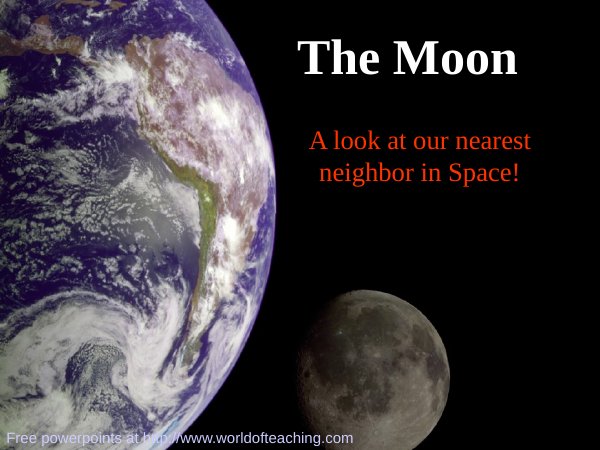
A thorough 65 slide presentation on the Moon. It covers how the Moon formed, its interior and surface features (highlands, craters and maria), its movements and phases, lunar and solar eclipses, the tides and Moon exploration. It finishes with the Lunar Challenge, a picture quiz on phases and features.
What this presentation covers
- How the Moon formed
- its interior
- highlands, craters and maria
- phases
- eclipses
- tides
- exploration
- the Lunar Challenge quiz
Level: KS2 / KS3
Slides: 65
Format: PowerPoint (.ppt)
Teaching notes
How to use it. At 65 slides this is too long for one lesson, so pick the sections you need: formation and features, phases, eclipses or tides. The Lunar Challenge quiz at the end makes a good plenary. For phases, a ball and a lamp in a darkened room is still the best demonstration, and a Moon diary kept over a month makes a great homework.
Key words
- Lunar phase: the shape of the sunlit part of the Moon we can see from Earth
- Waxing and waning: the lit part growing (waxing) or shrinking (waning)
- Maria: dark, flat plains of old solidified lava
- Crater: a bowl shaped hollow made by an impact
- Eclipse: when the Sun, Earth and Moon line up and one casts a shadow on another
Quick check questions
- Why do we always see the same side of the Moon?
- What are the dark patches on the Moon?
- How many high tides do most coasts have each day?
Show answers
- The Moon spins once on its axis in the same time it takes to orbit Earth.
- Maria: plains of old, solidified lava.
- Two, roughly every 12 and a half hours.
Related lessons: The Sun and Solar System | Planets and Orbits | Meteors and Meteor Showers