
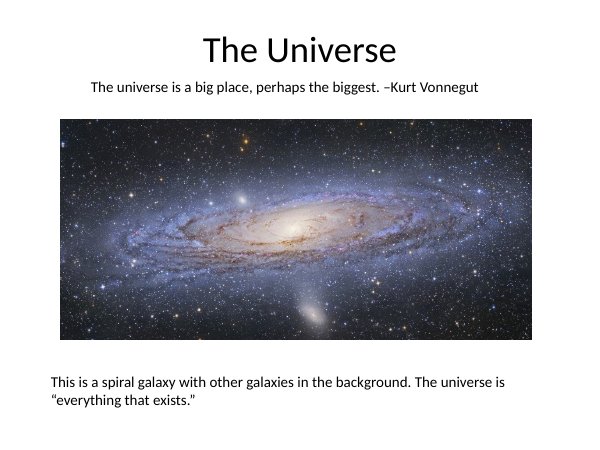
An introduction to cosmology. It moves from Newton’s idea of a static universe to Hubble’s discovery of redshift and what it tells us, the age of the universe and the Big Bang, the expanding universe, dark matter and dark energy, and the possible ways the universe could end.
What this presentation covers
- Cosmology
- Newton’s static universe
- Hubble and redshift
- the age of the universe
- the Big Bang
- dark matter and dark energy
- how the universe might end
Level: GCSE / A Level
Slides: 12
Format: PowerPoint (.pptx)
Teaching notes
How to use it. Pitched at GCSE Physics (Space physics in AQA) with some A level stretch. Redshift is the key idea, so it helps to show it before the slides: draw dots on a balloon and inflate it, and every dot moves away from every other dot. Finish with the question of how the universe might end, which makes a lively discussion.
Key words
- Cosmology: the study of the origin and development of the universe
- Redshift: light from distant galaxies stretched to longer wavelengths because they are moving away
- Big Bang: the theory that the universe began from a very small, hot, dense region about 13.8 billion years ago
- Dark matter: matter we cannot see but can detect from its gravity
- Dark energy: the unknown cause of the universe’s expansion speeding up
Quick check questions
- What does redshift tell us about distant galaxies?
- What did Hubble find about more distant galaxies?
- About how old is the universe?
Show answers
- They are moving away from us.
- The further away a galaxy is, the bigger its redshift, so the faster it is moving away.
- About 13.8 billion years.
Related lessons: Black Holes and Galaxies | Stars and the HR Diagram | History of Astronomy