
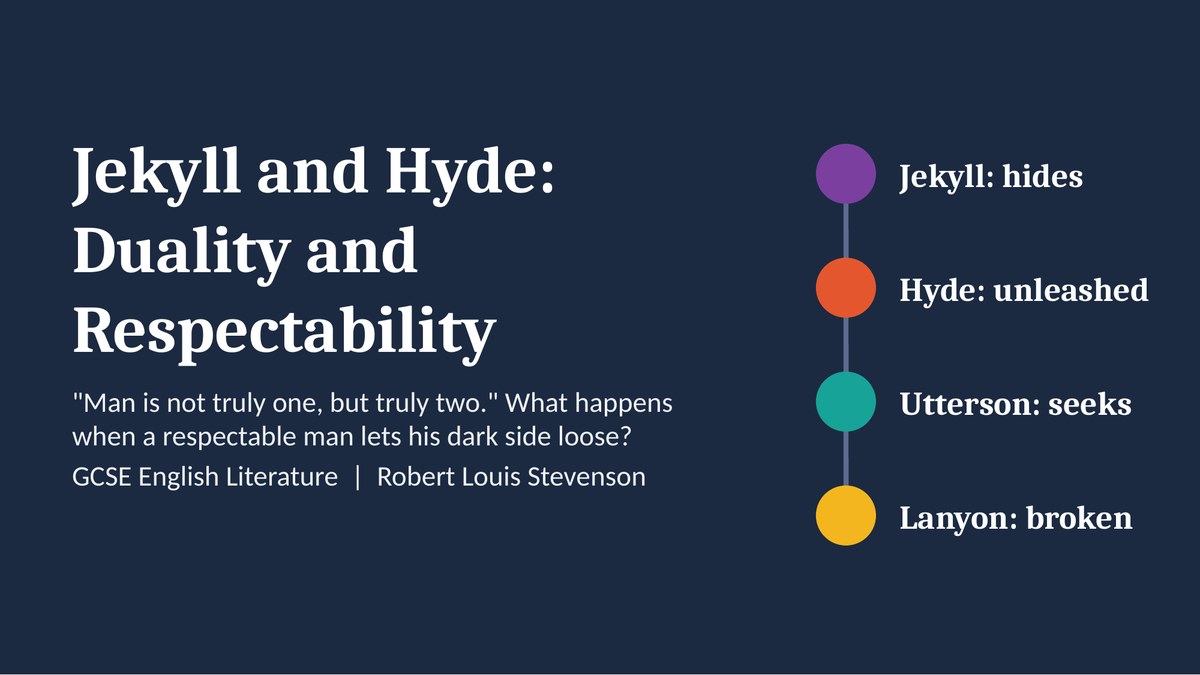
A complete, ready to teach GCSE English Literature lesson on Robert Louis Stevenson’s Strange Case of Dr Jekyll and Mr Hyde. Students explore how Stevenson presents Hyde as primitive and frightening, why the respectable Dr Jekyll “concealed” his pleasures, and how Utterson, Lanyon and a Gothic London help build the mystery. Every character is colour coded, and the lesson builds towards Jekyll’s own conclusion that “man is not truly one, but truly two”.
- 28 slides
- About 60 to 70 minutes
- All answers included
- Teacher notes on every slide
- Fully editable
Download this PowerPoint free (.pptx)
What the lesson covers
- Learning objectives at three levels: must, should and could.
- Warm up plot quiz with answers, and key words including duality, repression, Gothic and atavism.
- The big picture: a chapter timeline showing how the mystery is held back until the final letters.
- Context: Victorian respectability, Darwin and evolution, science and religion, and double lives in 1880s London.
- Mr Hyde: key quotations and analysis, including “trampled calmly”, “troglodytic” and “Satan’s signature upon a face”.
- Dr Jekyll: his full statement, the “primitive duality of man” and a side by side comparison of Jekyll and Hyde.
- Utterson, Lanyon and setting: the bargain of silence, Lanyon’s shock, the fog and the “blistered and distained” door.
- Quotation quizzes: a Hyde quiz and a “who said it?” quiz, with answers.
- Exam practice: an AQA style 19th century novel extract question (30 marks) on the trampling scene, a mark scheme and a model paragraph.
- Common mistakes, an exit ticket with answers and a key points summary.
Who it is for
GCSE English Literature students on AQA, Edexcel, OCR or Eduqas, in Year 10 or Year 11, and useful for revision before mocks. It sits well alongside our premium A Christmas Carol lesson, our An Inspector Calls lesson and our Macbeth lessons.
Download this PowerPoint free (.pptx)
More resources
Browse all premium PowerPoints or find more teacher made slides in our free literature PowerPoints.