
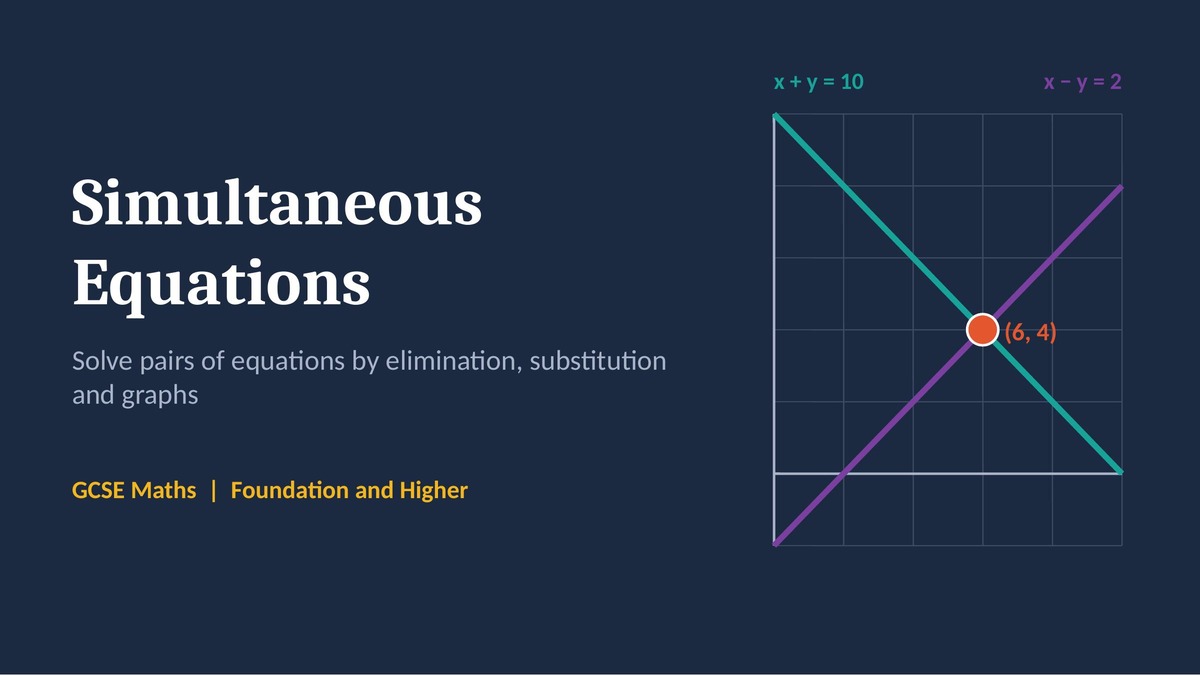
A complete, ready to teach GCSE maths lesson on simultaneous equations. Students see why one pair of values makes both equations true, using a graph where the two lines cross, then learn to solve by elimination, adding or subtracting equations and multiplying to match coefficients. Higher tier students go on to substitution and a linear and quadratic pair, and everyone forms and solves equations from real life problems.
- 29 slides
- About 60 minutes
- All answers included
- Teacher notes on every slide
- Editable diagrams
Download this PowerPoint free (.pptx)
What the lesson covers
- Learning objectives at three levels: must, should and could.
- Warm up on solving a simple equation, substitution, simplifying and multiplying every term, with answers.
- Key words: simultaneous, coefficient and eliminate.
- Key idea: one pair works for both, shown on a graph where x + y = 10 and x − y = 2 cross at (6, 4).
- The elimination method in five steps, plus a clear rule: same signs subtract, different signs add.
- Worked examples: subtracting, adding and multiplying one equation, then four your turn questions with answers.
- Harder pairs: multiplying both equations, solving by substitution, and a line and curve pair such as y = x² and y = x + 6 for Higher tier.
- Practice set of six pairs with a full answer slide.
- Problem solving: cinema ticket prices and a café order.
- Exam style question (5 marks) on the cost of pens and rulers, with an M1, A1, C1 mark scheme.
- Common mistakes, an exit ticket with answers and a key points summary.
Who it is for
GCSE maths, Foundation and Higher tier. The line and curve example is for Higher tier students. It follows on from our premium solving linear equations lesson, and the line and curve example uses the factorising skills from our premium expanding and factorising quadratics lesson.
Download this PowerPoint free (.pptx)
More resources
Browse all premium PowerPoints, try our free linear equations PowerPoint, or find more teacher made slides in our free algebra PowerPoints.