
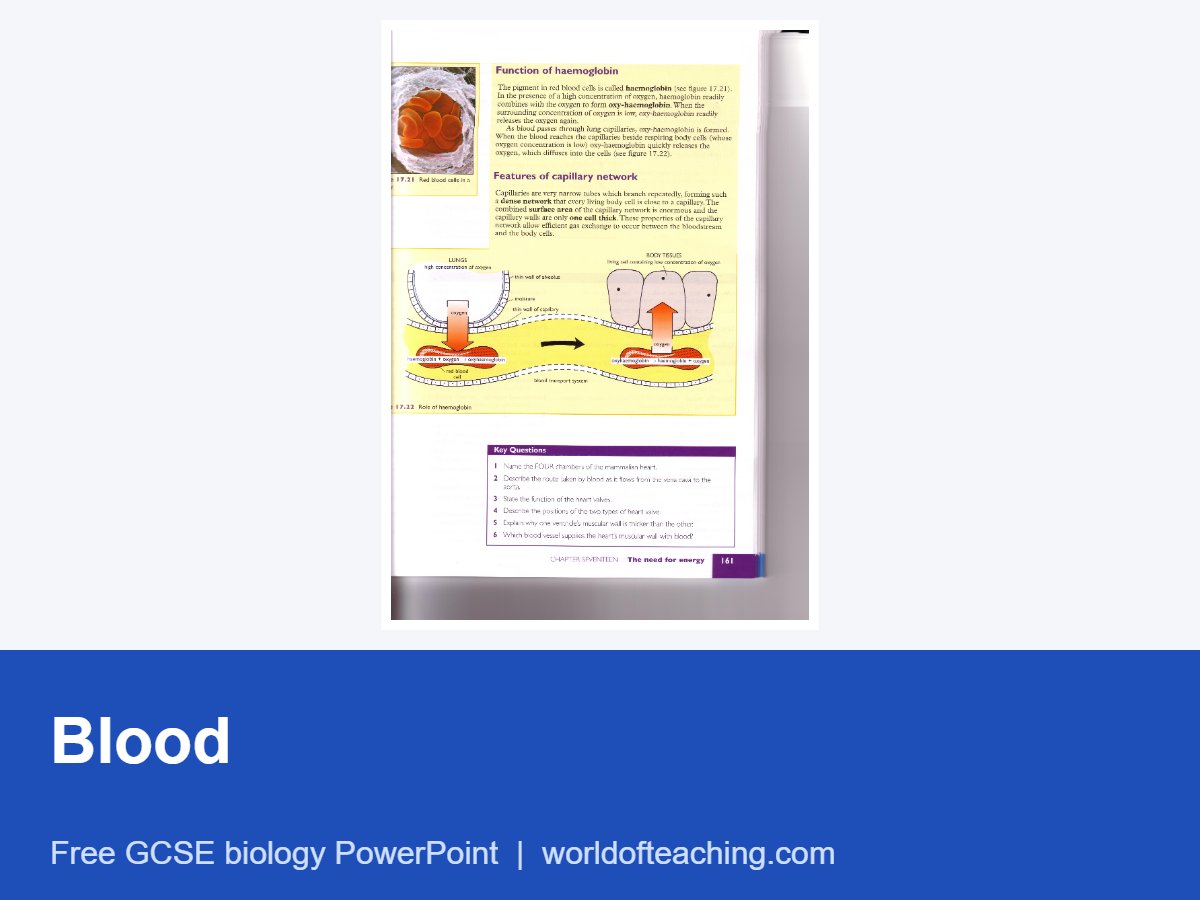
A lesson on the composition and functions of blood, illustrated with blood smear images. It covers plasma, red blood cells and haemoglobin, white blood cells and platelets, and introduces phagocytes and lymphocytes as part of the immune response.
What this presentation covers
- the composition of blood
- plasma and what it carries
- red blood cells and their adaptations
- haemoglobin and oxygen
- white blood cells
- platelets and blood clotting
- phagocytes and lymphocytes
Level: GCSE
Slides: 18
Format: PowerPoint (.pptx)
Teaching notes
How to use it. An 18 slide GCSE lesson (Organisation in AQA, with links to Infection and response). The blood smear images make it ideal to pair with a microscope practical using prepared slides: ask pupils to find and sketch each cell type. A table comparing the four components of blood, their structure and their job, is a quick and effective plenary.
Key words
- Plasma: the pale yellow liquid that carries cells, dissolved food, carbon dioxide, urea and hormones
- Red blood cell: a cell with no nucleus and a biconcave shape that carries oxygen
- Haemoglobin: the red protein that binds to oxygen in the lungs
- Platelet: a small fragment of a cell that helps the blood to clot
- Phagocyte: a white blood cell that engulfs and digests pathogens
Common misconception: “Blood is blue inside the body until it touches the air.” Blood is always red. It is bright red when full of oxygen and a darker red when it has given oxygen up. Veins only look blue because of the way light passes through the skin.
Quick check questions
- Why do red blood cells have no nucleus?
- What is the job of platelets?
- Name the two main types of white blood cell and say what each does.
Show answers
- It leaves more room for haemoglobin, so each cell can carry more oxygen.
- To help the blood clot at a wound.
- Phagocytes engulf pathogens; lymphocytes make antibodies.
Related lessons: The Immune System | The Lungs | Homeostasis
New free lessons every week.Follow World of Teaching on Facebook so you never miss one.Follow on Facebook