
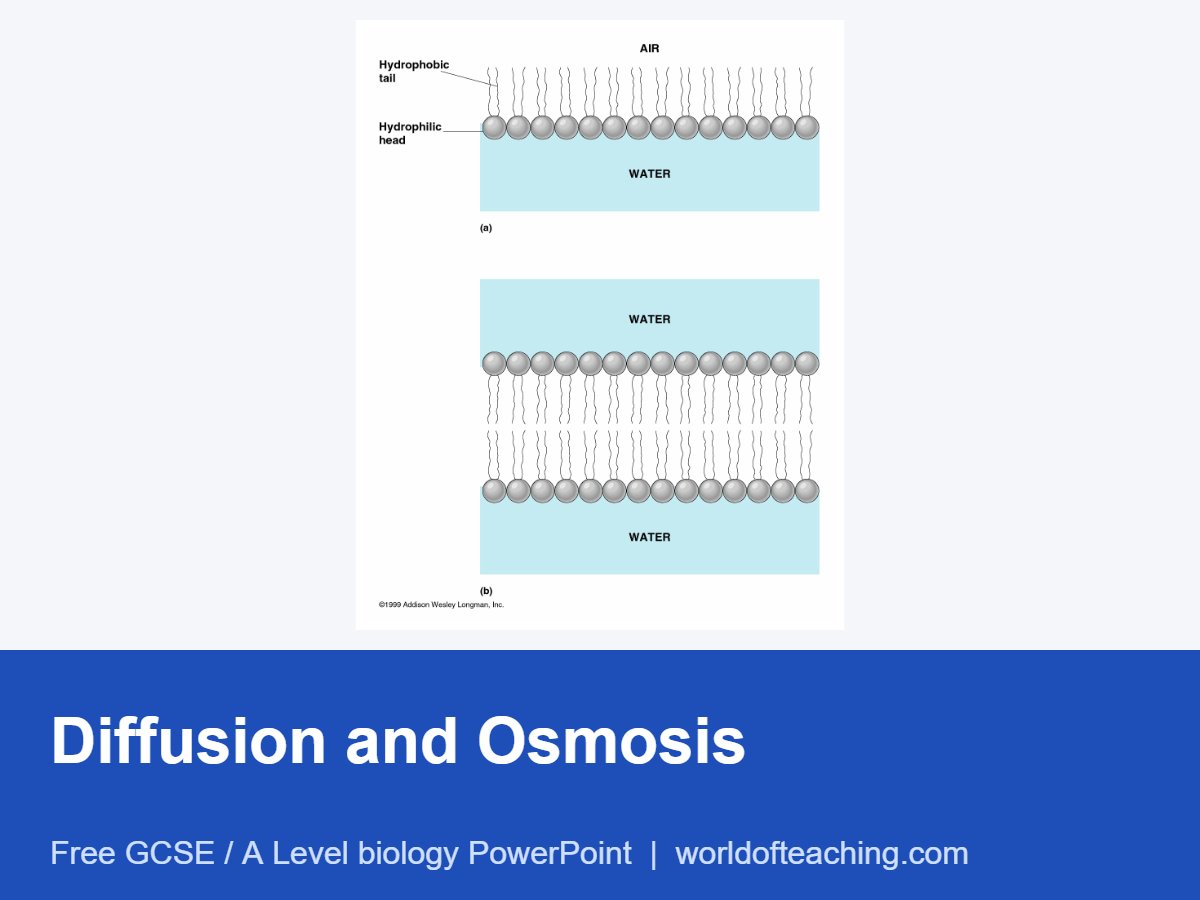
A lesson on cell membranes and how substances move across them. It explains membrane structure and the fluid mosaic model, then compares diffusion, osmosis, facilitated diffusion and active transport, with a set of practical activities using dialysis tubing, beetroot and an osmometer.
What this presentation covers
- functions of membranes
- the phospholipid bilayer and fluid mosaic model
- the blood brain barrier
- solutes, solvents and solutions
- diffusion, osmosis, facilitated diffusion and active transport
- hypotonic, hypertonic and isotonic solutions
- plant and animal cells in different solutions
- membrane practicals with tests for starch, chloride and sulfate ions
Level: GCSE / A Level
Slides: 22
Format: PowerPoint (.pptx)
Teaching notes
How to use it. This covers GCSE transport across membranes and goes on into A level detail with the fluid mosaic model. The potato or beetroot practical is the obvious follow up and is an AQA required practical: pupils measure the change in mass of potato pieces in different sugar or salt solutions. Comparing the three processes in a table is a reliable exam question.
Key words
- Diffusion: the net movement of particles from a higher to a lower concentration
- Osmosis: the diffusion of water across a partially permeable membrane
- Active transport: moving substances against a concentration gradient, using energy from respiration
- Partially permeable membrane: a membrane that lets some molecules through but not others
- Isotonic: a solution with the same water concentration as the cell
Quick check questions
- What is the difference between diffusion and active transport?
- What happens to a red blood cell placed in pure water?
- Why do root hair cells need active transport?
Show answers
- Diffusion is passive and goes down a concentration gradient; active transport needs energy and goes against it.
- Water enters by osmosis, so it swells and may burst.
- To absorb mineral ions from the soil, where they are at a lower concentration than inside the root.
Related lessons: Transport in Plants | Osmosis revision (premium) | Active Transport revision (premium)