
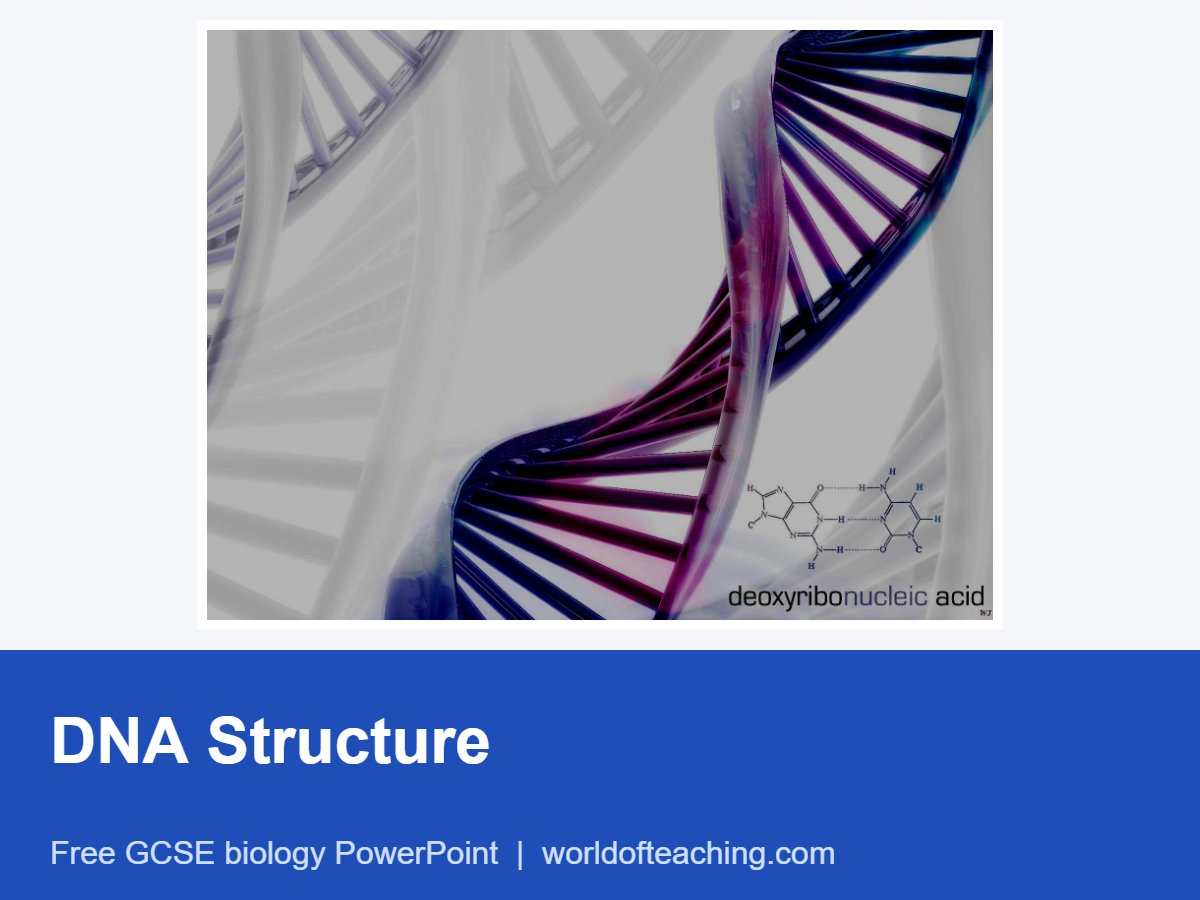
A clear lesson on the structure of DNA. It explains the double helix, nucleotides and complementary base pairing, then shows how the order of bases forms a code and how a gene codes for a protein. It ends with a flow chart task linking DNA, genes, proteins and traits.
What this presentation covers
- the double helix
- nucleotides: phosphate, sugar and base
- the four bases A, T, G and C
- complementary base pairing
- the genetic code
- genes and proteins
- flow chart task: DNA to gene to protein to trait
Level: GCSE
Slides: 13
Format: PowerPoint (.pptx)
Teaching notes
How to use it. This lesson suits GCSE Biology (Inheritance, variation and evolution in AQA) and KS3 genetics. The flow chart task at the end is a good check that pupils can link DNA, genes, proteins and characteristics. Building a paper or sweet model of a short DNA section is a memorable follow up.
Key words
- Nucleotide: the repeating unit of DNA: a phosphate, a sugar and a base
- Double helix: the twisted ladder shape of a DNA molecule
- Complementary base pairing: A always pairs with T, and C always pairs with G
- Gene: a section of DNA that codes for a particular protein
- Genome: all the genetic material of an organism
Common misconception: “A pairs with G and C pairs with T.” The pairs are A with T and C with G. A quick memory aid: Apple Tree, Car Garage.
Quick check questions
- Write the complementary strand for ATTGC.
- Name the three parts of a nucleotide.
- If 20% of the bases in a DNA sample are A, what percentage are G?
Show answers
- TAACG.
- A phosphate group, a sugar (deoxyribose) and a base.
- 30%. T is also 20%, leaving 60% shared equally between G and C.
Related lessons: Protein Synthesis | PCR | Gregor Mendel
New free lessons every week.Follow World of Teaching on Facebook so you never miss one.Follow on Facebook