
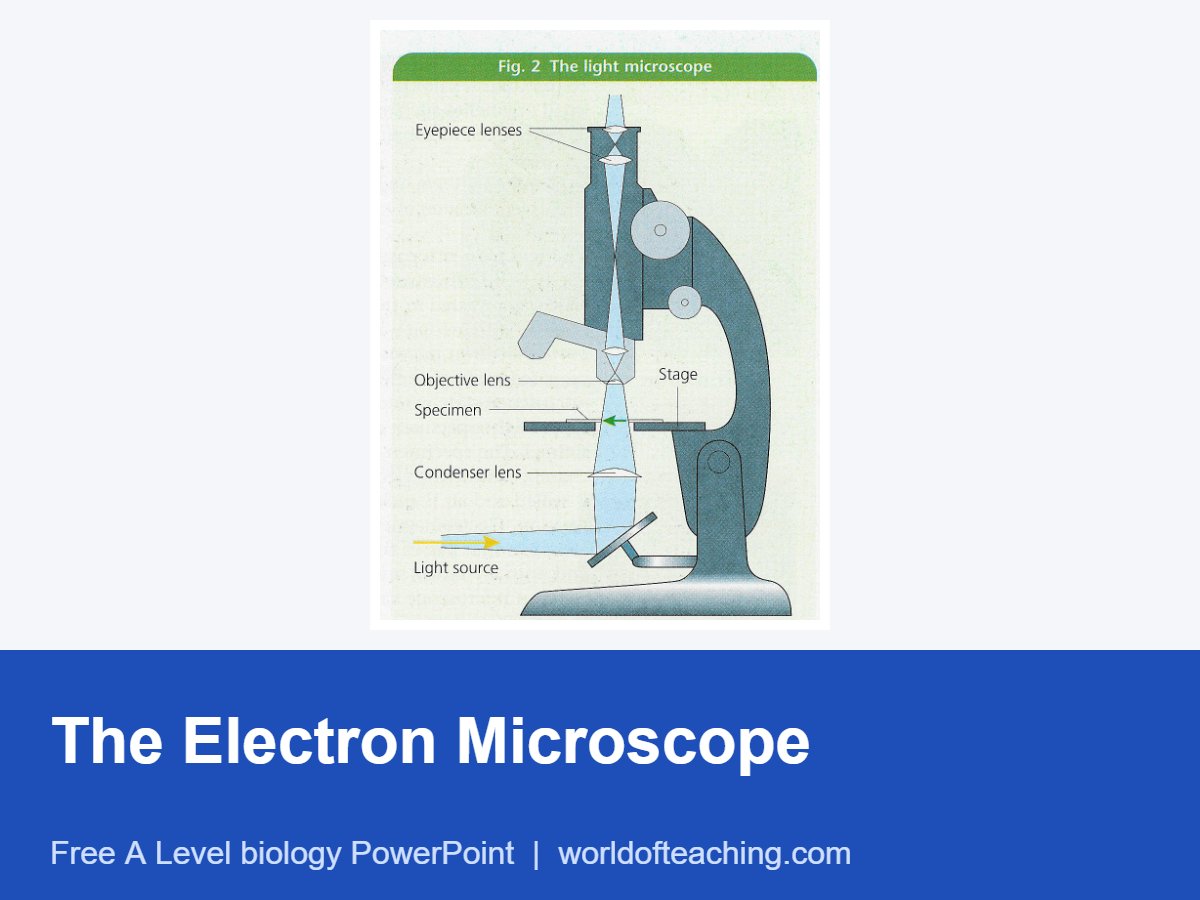
An AS Biology lesson comparing light and electron microscopes. It explains magnification and resolving power, why electrons give a much higher resolution, and how transmission and scanning electron microscopes work, finishing with a comparison table.
What this presentation covers
- magnification and resolution
- resolving power and wavelength
- the light microscope
- how electron microscopes work
- transmission electron microscopy (TEM) and specimen preparation
- scanning electron microscopy (SEM)
- light versus electron microscope comparison
Level: A Level
Slides: 17
Format: PowerPoint (.pptx)
Teaching notes
How to use it. This lesson is pitched at AS Biology but the comparison between light and electron microscopes is also on the GCSE specification, so it works for higher attaining GCSE groups too. Use the comparison table at the end as a retrieval task: hide one column and ask pupils to fill it in from memory.
Key words
- Magnification: how many times bigger the image is than the real object
- Resolution: the ability to tell two points apart as separate
- TEM: transmission electron microscope: electrons pass through a thin specimen, giving detailed 2D images
- SEM: scanning electron microscope: electrons bounce off the surface, giving 3D images
- Artefact: something seen in an image that was caused by preparing the specimen
Common misconception: “More magnification always means more detail.” Detail depends on resolution. Magnifying beyond the resolution limit just makes a bigger, blurrier image. Electron microscopes resolve far more because electrons have a much shorter wavelength than light.
Quick check questions
- An image is 5 mm long and the real object is 50 µm. What is the magnification?
- Why must specimens for an electron microscope be dead?
- Give one difference between a TEM and an SEM image.
Show answers
- 5 mm = 5,000 µm, and 5,000 ÷ 50 = ×100.
- They are viewed in a vacuum.
- A TEM shows internal detail in 2D; an SEM shows the surface in 3D.
Related lessons: The Microscope | Microscopy revision (premium) | Cell Structure revision (premium)
New free lessons every week.Follow World of Teaching on Facebook so you never miss one.Follow on Facebook