
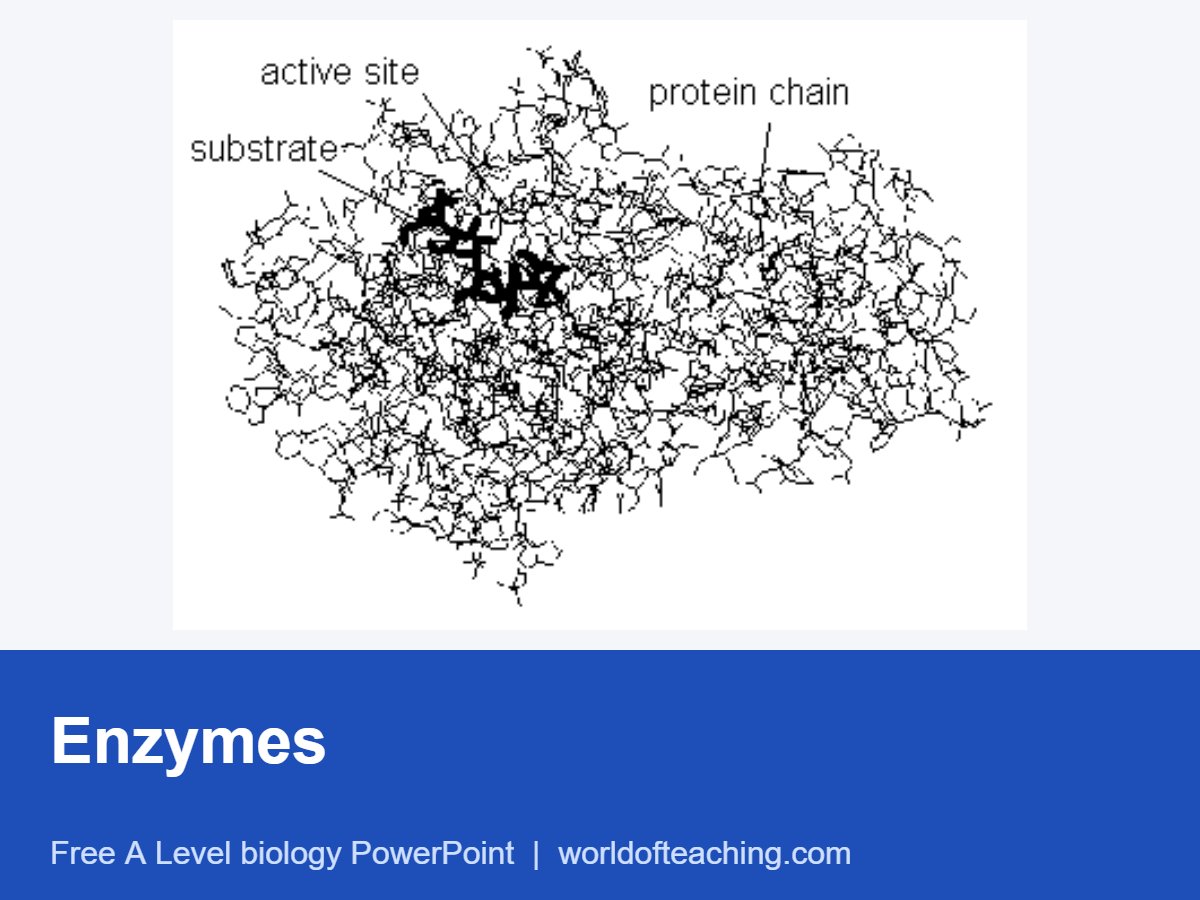
An introductory AS Biology lesson on enzymes as biological catalysts. It sets out the unit objectives, links back to digestive enzymes students already know, and explains how enzymes work through the lock and key idea and activation energy before looking at the factors that affect the rate of reaction.
What this presentation covers
- enzymes as globular proteins and biological catalysts
- amylase and starch as an example
- how enzymes work: substrate, active site and product
- the lock and key model
- activation energy
- factors affecting rate, including substrate concentration
Level: A Level
Slides: 14
Format: PowerPoint (.pptx)
Teaching notes
How to use it. An introductory A level lesson that links back to the digestive enzymes pupils met at GCSE. A good follow up is the classic practical timing how long amylase takes to break down starch at different temperatures or pH values, testing samples with iodine. Ask pupils to sketch a rate graph before the practical and compare their prediction with the results.
Key words
- Enzyme: a protein that acts as a biological catalyst
- Active site: the part of the enzyme where the substrate binds
- Substrate: the molecule an enzyme acts on
- Activation energy: the energy needed to start a reaction, which enzymes lower
- Denatured: when an enzyme’s active site changes shape so the substrate no longer fits
Quick check questions
- What do enzymes do to the activation energy of a reaction?
- Why does the rate stop rising at high substrate concentrations?
- What happens to an enzyme above its optimum temperature?
Show answers
- They lower it.
- All the active sites are occupied, so the amount of enzyme becomes the limiting factor.
- It denatures: the active site changes shape and the rate falls quickly.
Related lessons: Protein Structure | Krebs Cycle | Protein Synthesis