
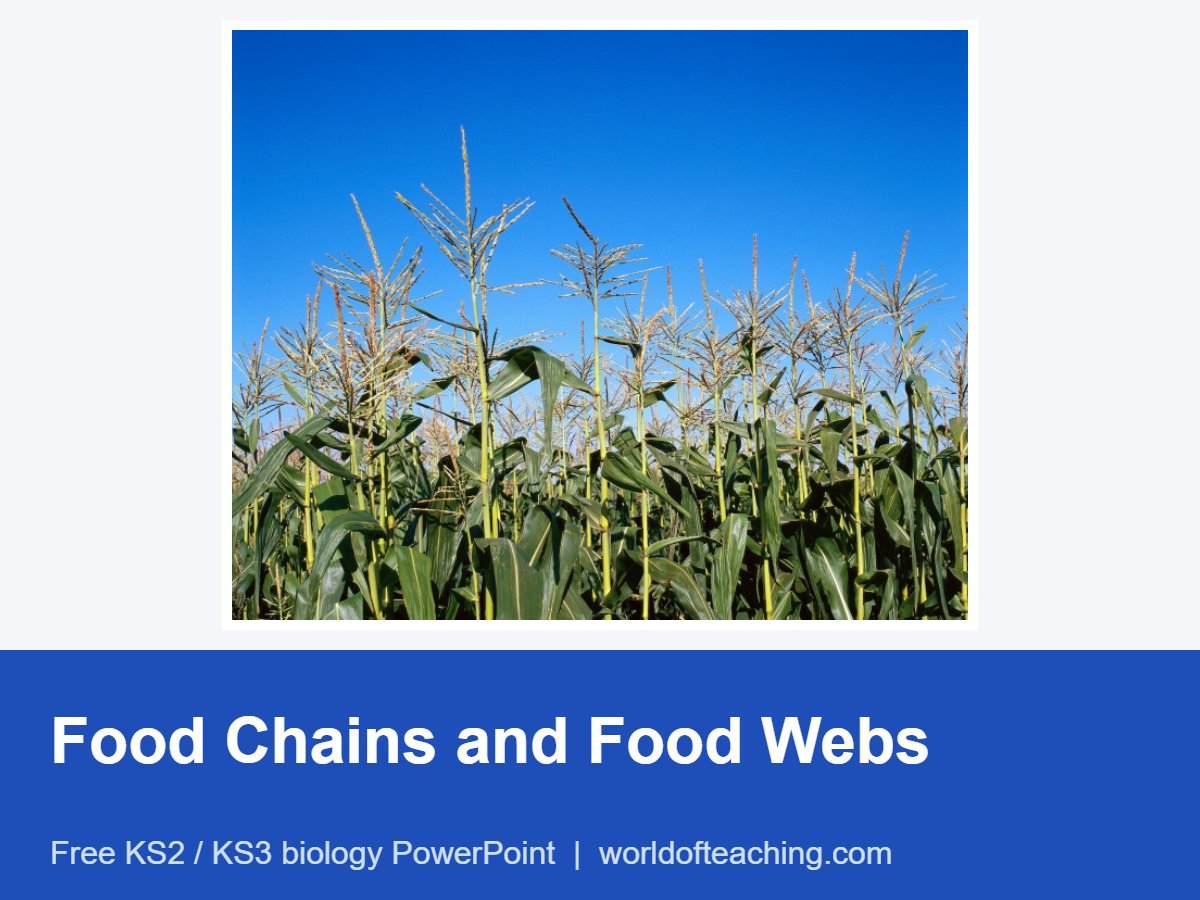
A friendly introduction to food chains and food webs. It explains producers and the levels of consumers, the difference between herbivores, carnivores and omnivores, and the roles of scavengers and decomposers in returning nutrients to the soil.
What this presentation covers
- food chains and food webs
- producers and energy from the Sun
- primary, secondary and tertiary consumers
- herbivores, carnivores and omnivores
- scavengers
- decomposers and recycling nutrients
Level: KS2 / KS3
Slides: 16
Format: PowerPoint (.pptx)
Teaching notes
How to use it. Made for KS2 and KS3. A quick starter is to give each pupil a card with a plant or animal on it and ask the class to link themselves into chains with string. Once the food web is built, ask what would happen if one animal disappeared, which leads naturally into how everything in an ecosystem is connected.
Key words
- Producer: a green plant that makes its own food using light from the Sun
- Consumer: an animal that gets its energy by eating other living things
- Herbivore: an animal that eats only plants
- Carnivore: an animal that eats only other animals
- Decomposer: a living thing, such as a fungus or bacterium, that breaks down dead material
Common misconception: “The arrows in a food chain point to the thing that gets eaten.” The arrows show which way the energy flows, so they point from the food to the animal that eats it: grass → rabbit → fox.
Quick check questions
- What is at the start of almost every food chain?
- In the chain grass → rabbit → fox, what is the fox?
- Why are decomposers important?
Show answers
- A green plant, which is the producer.
- A secondary consumer and a carnivore.
- They break down dead plants and animals and return nutrients to the soil.
Related lessons: Photosynthesis | Animal Classification | Teeth
New free lessons every week.Follow World of Teaching on Facebook so you never miss one.Follow on Facebook