
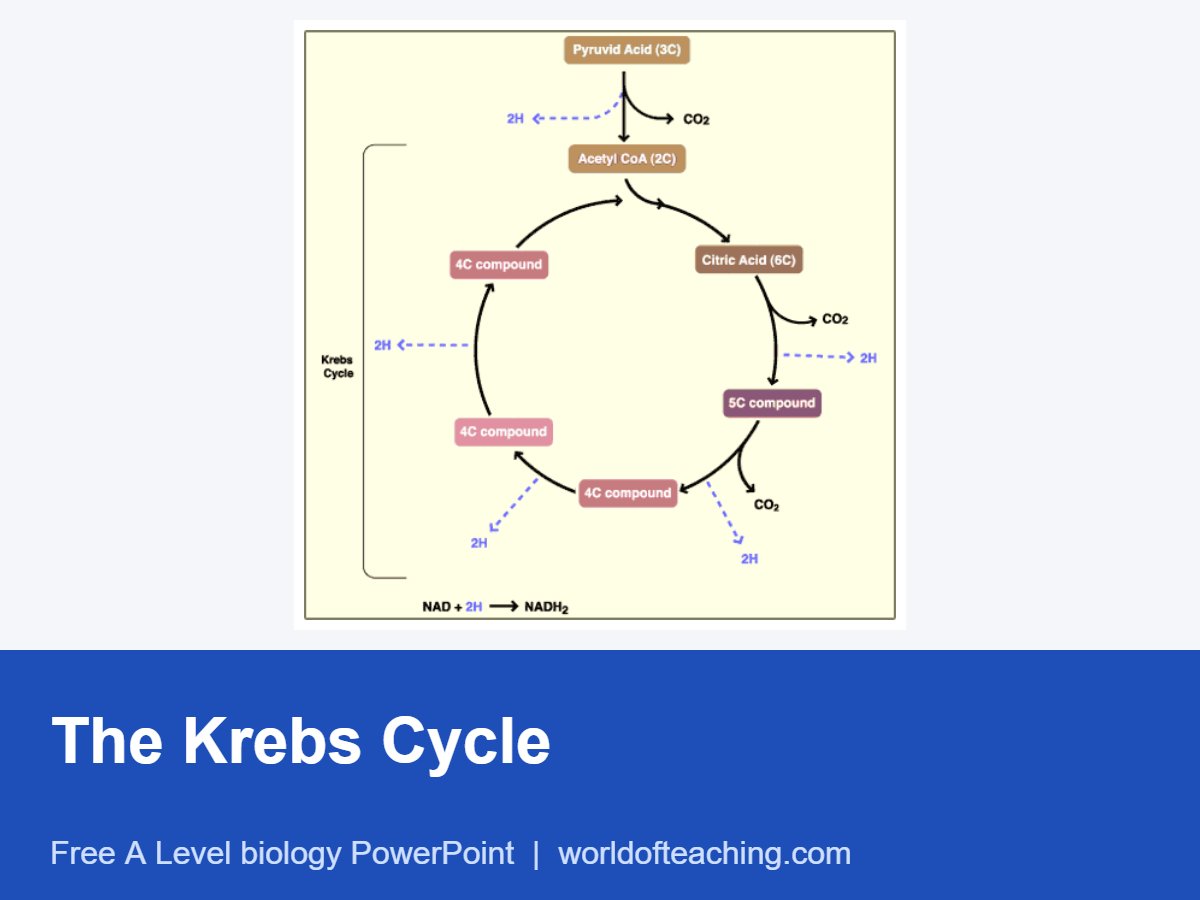
A short A Level summary of the aerobic stages of respiration. It covers the Krebs cycle in the mitochondrial matrix, the cytochrome system and oxidative phosphorylation, and the role of oxygen as the final hydrogen acceptor.
What this presentation covers
- where the Krebs cycle happens
- the 2 carbon and 4 carbon compounds and citric acid
- release of hydrogen and NAD
- the cytochrome system
- ATP from oxidative phosphorylation
- oxygen as the final hydrogen acceptor
Level: A Level
Slides: 8
Format: PowerPoint (.pptx)
Teaching notes
How to use it. A concise 8 slide A Level summary of the aerobic stages of respiration, ideal for consolidation after a fuller lesson or as a revision aid. Pupils remember the stages far better if they build a large flow diagram as you go, from glycolysis to the link reaction, the Krebs cycle and oxidative phosphorylation, adding where each stage happens and what it produces. Finish by asking why respiration stops without oxygen.
Key words
- Mitochondrial matrix: the fluid inside the mitochondrion where the Krebs cycle takes place
- Krebs cycle: a series of reactions that releases carbon dioxide and hydrogen from acetyl groups
- NAD: a coenzyme that carries hydrogen to the electron transport chain
- Oxidative phosphorylation: the making of ATP using energy released as electrons pass along the electron transport chain
- Final electron acceptor: oxygen, which combines with electrons and hydrogen ions to form water
Quick check questions
- Where in the cell does the Krebs cycle take place?
- Which gas is released during the Krebs cycle?
- What is the role of oxygen in aerobic respiration?
Show answers
- In the mitochondrial matrix.
- Carbon dioxide.
- It is the final electron (hydrogen) acceptor, forming water.
Related lessons: Aerobic and Anaerobic Respiration | Enzymes | Photosynthesis