
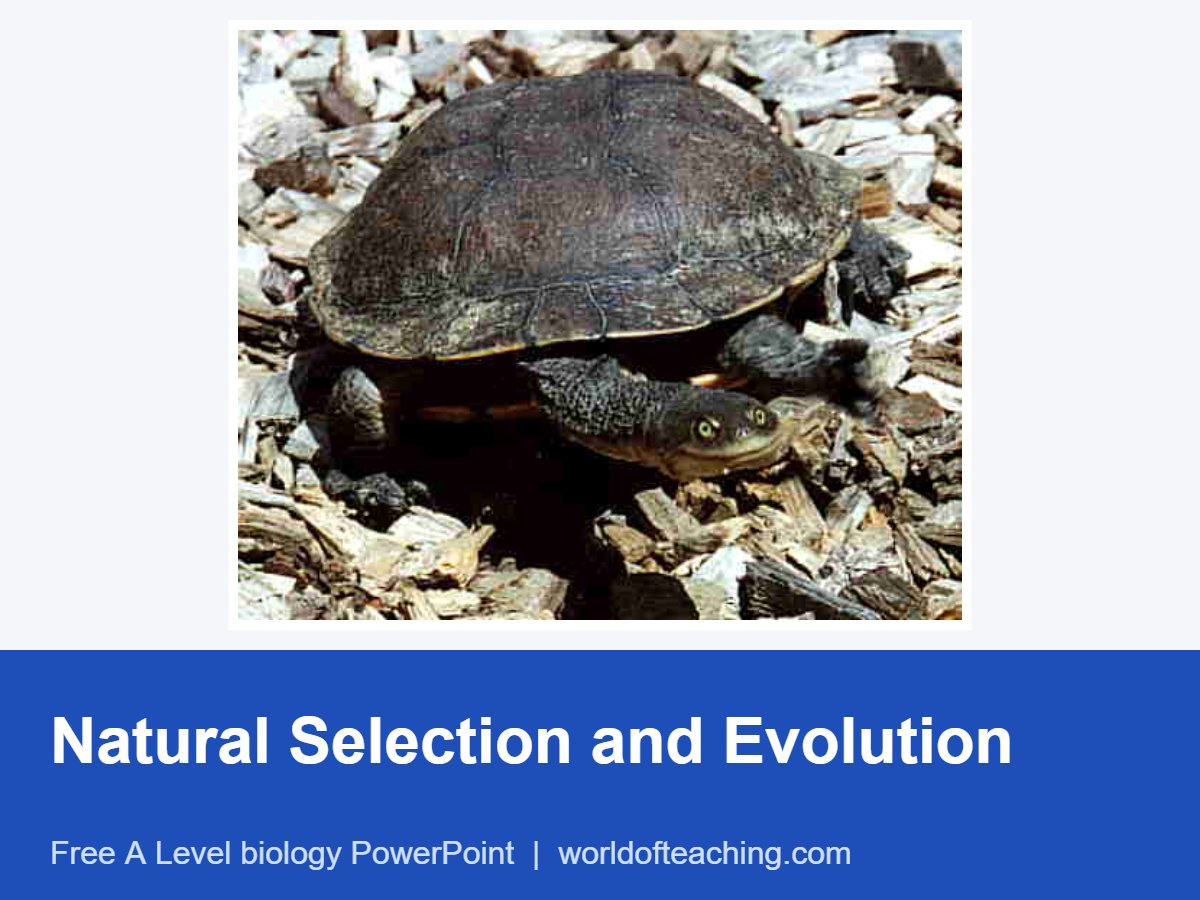
A comprehensive presentation on evolution and natural selection. It compares Lamarck’s ideas with Darwin’s, sets out Darwin’s voyage and theory, and covers the evidence for evolution, then moves on to population genetics, Hardy Weinberg, genetic drift, types of selection, speciation and reproductive barriers.
What this presentation covers
- Lamarck and the inheritance of acquired characteristics
- Darwin, the Beagle and On the Origin of Species
- natural and artificial selection
- evidence for evolution
- populations, species and gene pools
- the Hardy Weinberg principle
- genetic drift, bottleneck and founder effects, gene flow and mutation
- stabilising, directional and diversifying selection
- speciation and reproductive barriers
- adaptive radiation, convergent evolution and coevolution
Level: A Level
Slides: 44
Format: PowerPoint (.pptx)
Teaching notes
How to use it. The first half (Lamarck, Darwin and the evidence for evolution) suits GCSE, while the later slides on population genetics, Hardy Weinberg, genetic drift and speciation are aimed at A level. You can split it across two lessons, or use the second half as stretch material for able GCSE groups.
Key words
- Variation: differences between individuals of the same species, often caused by mutation
- Natural selection: individuals best suited to their environment survive and pass on their alleles
- Adaptation: a feature that helps an organism survive in its environment
- Speciation: the formation of a new species when populations can no longer interbreed
- Genetic drift: random changes in allele frequency, strongest in small populations
Common misconception: “Animals evolve because they need to, within their own lifetime.” That is Lamarck’s idea. Individuals do not evolve; populations do, over many generations, because variation already exists and some variants survive and reproduce more.
Quick check questions
- Give one piece of evidence for evolution.
- Why was Darwin’s theory accepted over Lamarck’s?
- In a population, q squared is 0.16. What are q and p?
Show answers
- Any one of: fossils, antibiotic resistance in bacteria, or similarities in DNA between species.
- Characteristics gained during a lifetime are not passed on to offspring; Darwin’s idea of variation and selection explained the evidence.
- q = 0.4 and p = 0.6, because p + q = 1.
Related lessons: Gregor Mendel | Genetic Crosses | DNA Structure
New free lessons every week.Follow World of Teaching on Facebook so you never miss one.Follow on Facebook