
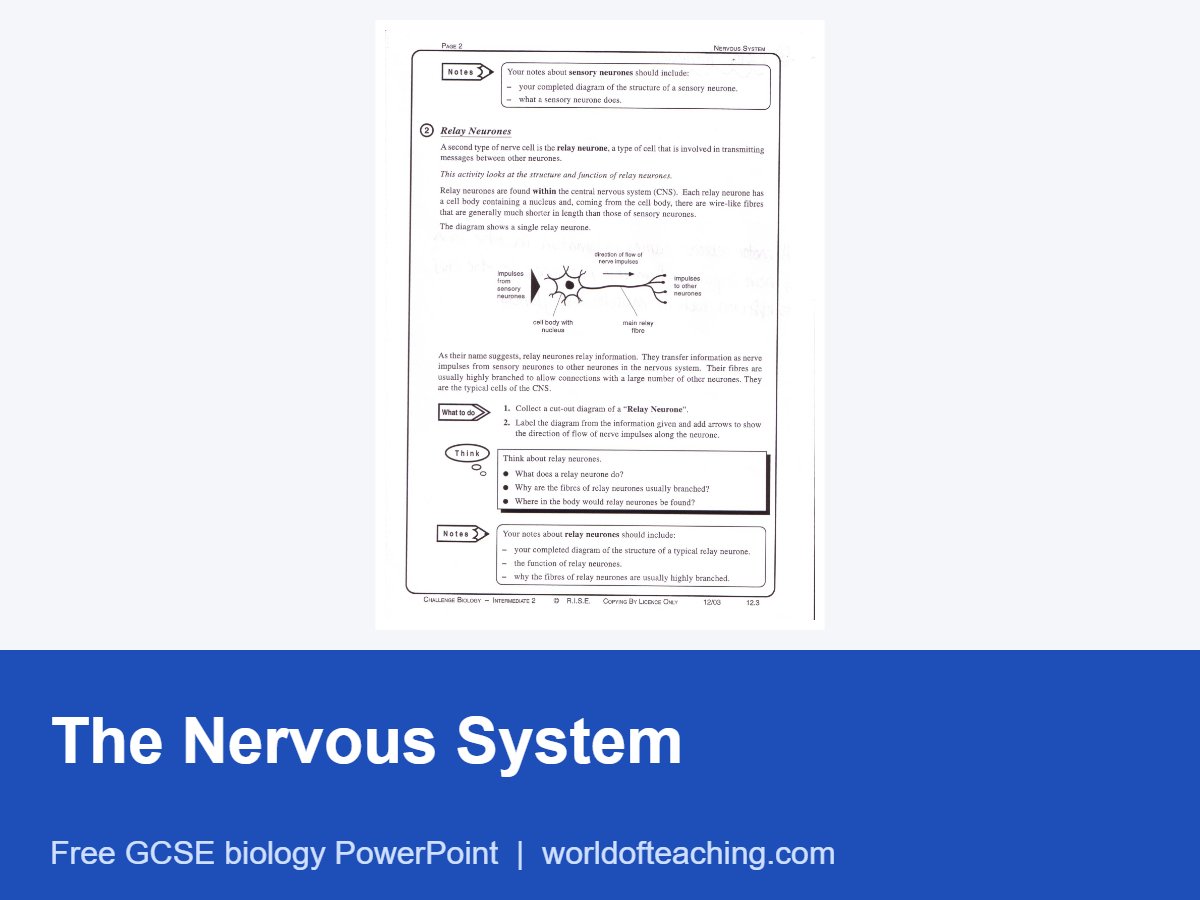
A lesson on the nervous system and how impulses travel. It covers basic nerve cell structure, the three types of neurone and their jobs, how signals are transmitted, and the synapse, with a link to Parkinson’s disease.
What this presentation covers
- the parts of the nervous system
- nerve cell structure
- sensory, relay and motor neurones
- receptors and effectors
- transmission of impulses
- the synapse
- Parkinson’s disease
Level: GCSE
Slides: 11
Format: PowerPoint (.pptx)
Teaching notes
How to use it. An 11 slide lesson for GCSE Biology (Homeostasis and response in AQA). A reaction time practical with a dropped ruler fits naturally alongside it, and gives pupils real data to analyse. Ask them to draw the pathway from receptor to effector as a flow chart, then add the three types of neurone to it.
Key words
- Receptor: a cell that detects a stimulus, such as light or heat
- Effector: a muscle or gland that produces a response
- Sensory neurone: carries impulses from receptors to the central nervous system
- Relay neurone: connects sensory and motor neurones inside the central nervous system
- Synapse: the tiny gap between two neurones, crossed by chemical transmitters
Common misconception: “The electrical impulse jumps across the synapse.” The signal crosses the synapse as a chemical. The neurone releases a transmitter that diffuses across the gap and starts a new impulse in the next neurone.
Quick check questions
- Put these in order: motor neurone, receptor, effector, sensory neurone, relay neurone.
- How does a signal cross a synapse?
- Which two organs make up the central nervous system?
Show answers
- Receptor, sensory neurone, relay neurone, motor neurone, effector.
- A chemical transmitter is released and diffuses across the gap to the next neurone.
- The brain and the spinal cord.
Related lessons: The Neuron | Homeostasis | Specialised Cells
New free lessons every week.Follow World of Teaching on Facebook so you never miss one.Follow on Facebook