
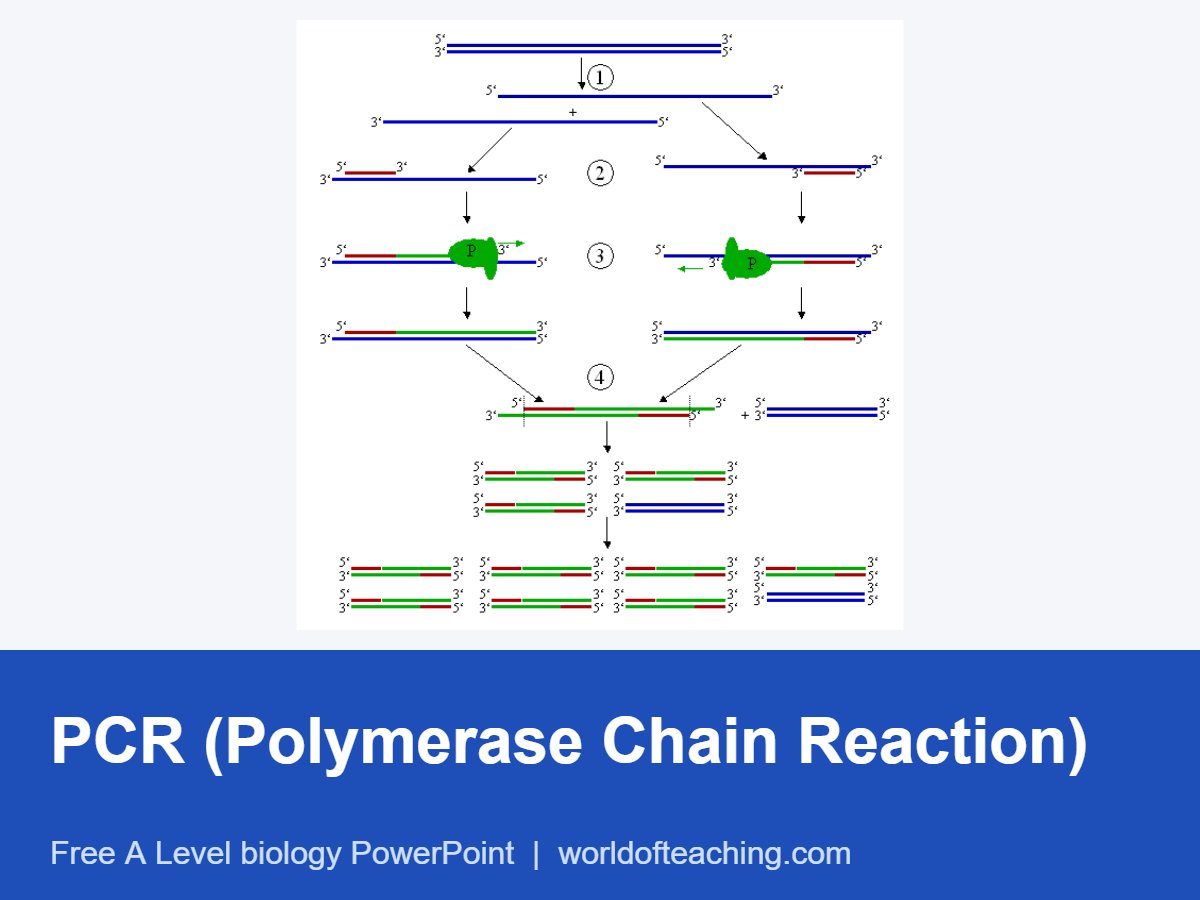
A lesson on the polymerase chain reaction with a starter, aims and animation links. It explains what goes into a PCR machine, the heating and cooling steps, how primers are designed, why a thermostable DNA polymerase is needed and why contamination must be avoided, finishing with the uses of PCR.
What this presentation covers
- what PCR is for
- the reaction mix: DNA, nucleotides, primers and polymerase
- separating strands at 95 degrees
- designing primers
- thermostable DNA polymerase
- avoiding contamination
- uses of PCR
Level: A Level
Slides: 14
Format: PowerPoint (.pptx)
Teaching notes
How to use it. Best for A level Biology or as extension for separate science GCSE. Pupils find PCR much easier once they see it as a cycle that repeats: heat to separate, cool to let primers bind, warm for the polymerase to build. Ask them to work out how many copies there are after a few cycles, because the doubling makes the point about why PCR is so powerful.
Key words
- Primer: a short single strand of DNA that marks where copying starts
- DNA polymerase: the enzyme that joins free nucleotides to build the new strand
- Denaturation: heating to about 95 °C to separate the two DNA strands
- Annealing: cooling so the primers can bind to the separated strands
- Thermostable: able to work at high temperatures without denaturing
Quick check questions
- Why is a thermostable DNA polymerase such as Taq used?
- Starting with one DNA molecule, how many copies are there after 10 cycles?
- Give two uses of PCR.
Show answers
- It does not denature at the high temperatures used to separate the strands.
- 1,024, because the number doubles every cycle (2 to the power 10).
- Any two of: forensic DNA profiling, diagnosing infections, paternity testing, genetic research.
Related lessons: DNA Structure | Genetic Engineering | Protein Synthesis