
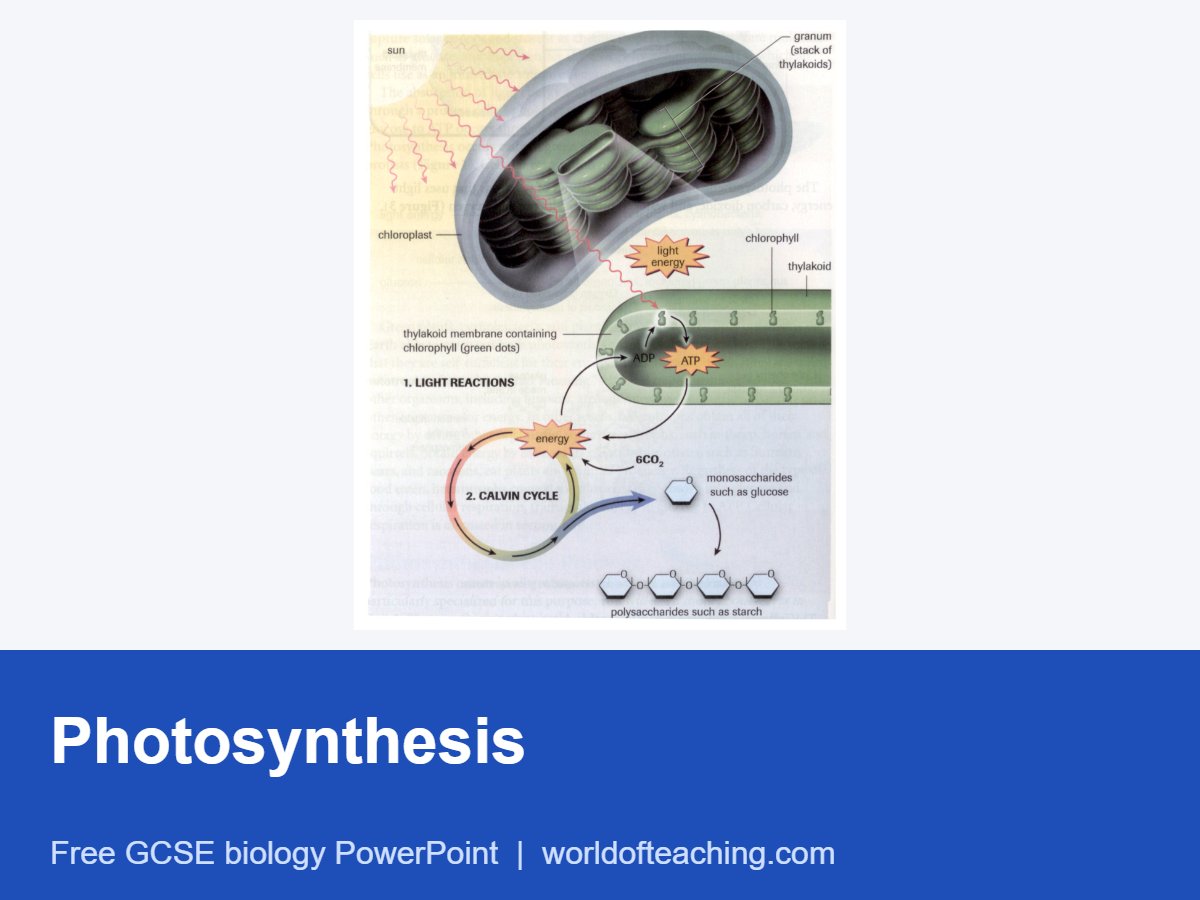
A clear overview of photosynthesis. It explains why almost all energy on Earth comes from the Sun, the structure of chloroplasts and chlorophyll, the light dependent and light independent reactions and the overall equation, and finishes with an activity on why leaves change colour in autumn.
What this presentation covers
- producers and energy from the Sun
- inputs and outputs of photosynthesis
- chloroplast structure and thylakoids
- chlorophyll as a light antenna
- light dependent reactions
- light independent reactions
- the word equation
- leaf pigments and autumn colours
Level: GCSE
Slides: 12
Format: PowerPoint (.pptx)
Teaching notes
How to use it. This lesson fits GCSE Biology (Bioenergetics in AQA). The light dependent and light independent slides go a little beyond most GCSE courses, so you can skim them with GCSE groups or use them as stretch. The required practical on light intensity, counting bubbles from pondweed at different distances from a lamp, is the natural follow up, and the autumn leaves activity makes a good homework.
Key words
- Photosynthesis: the process plants use to make glucose from carbon dioxide and water using light energy
- Chlorophyll: the green pigment in chloroplasts that absorbs light
- Chloroplast: the organelle where photosynthesis happens
- Endothermic: a reaction that takes in energy from the surroundings
- Limiting factor: whatever is in shortest supply and so holds back the rate: light, carbon dioxide or temperature
Quick check questions
- Write the word equation for photosynthesis.
- Why do leaves change colour in autumn?
- Name two factors that can limit the rate of photosynthesis.
Show answers
- Carbon dioxide + water → glucose + oxygen (using light energy).
- The chlorophyll breaks down, revealing the yellow and orange pigments that were there all along.
- Any two of: light intensity, carbon dioxide concentration, temperature.
Related lessons: Transport in Plants | Aerobic and Anaerobic Respiration | Food Chains and Webs