
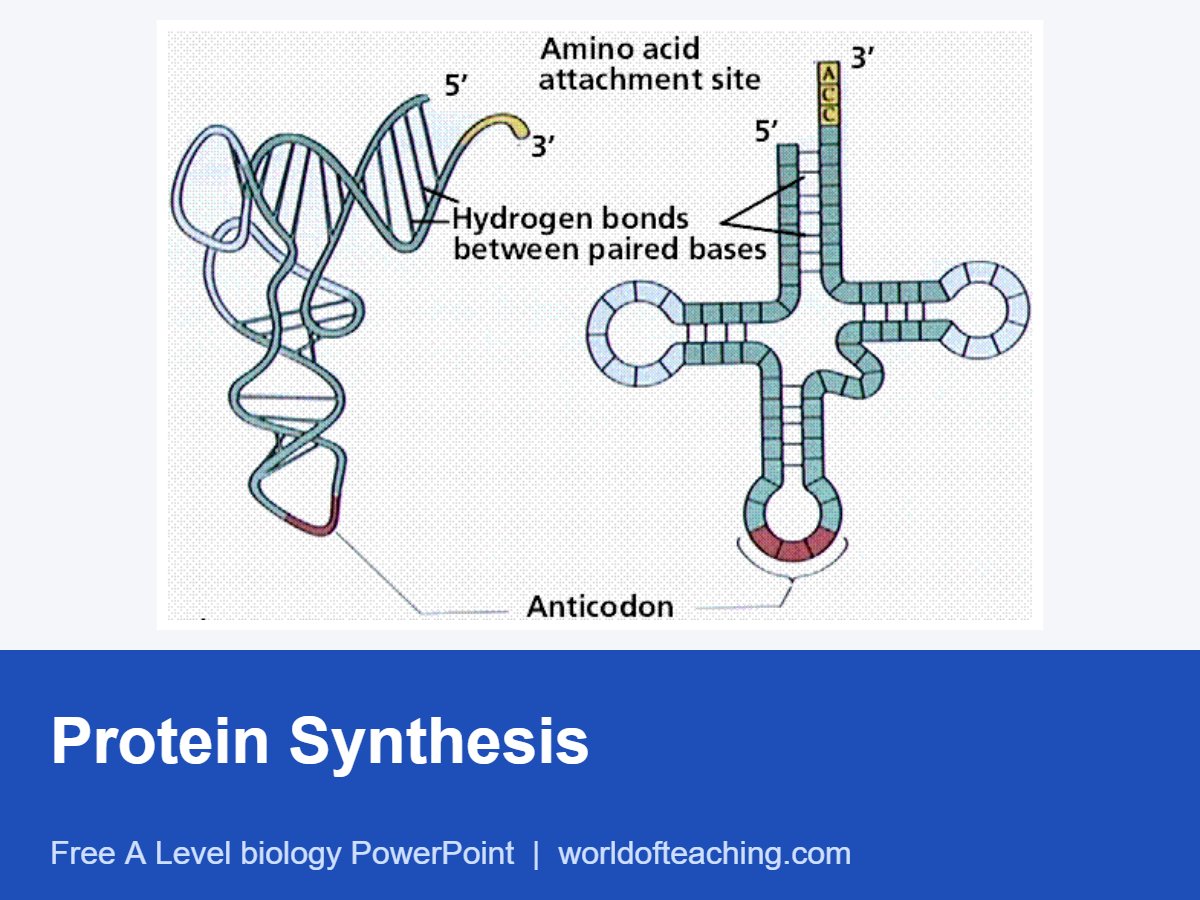
An AS Biology lesson covering transcription and translation in detail. It shows how an mRNA copy of a gene is made by RNA polymerase, how tRNA collects amino acids, and how ribosomes read codons to build a polypeptide, ending with the rough endoplasmic reticulum.
What this presentation covers
- an overview of protein synthesis
- transcription and RNA polymerase
- mRNA leaving the nucleus
- tRNA and amino acids
- translation at the ribosome, codon by codon
- stop codons and the finished polypeptide
- the rough endoplasmic reticulum and ribosomes
Level: A Level
Slides: 26
Format: PowerPoint (.pptx)
Teaching notes
How to use it. Pitched at AS Biology, with the overview slides also suitable for GCSE separate science. Pupils often mix up the roles of the three types of RNA, so it is worth pausing after transcription and after translation for a quick quiz. A card sort of the steps in order works well as a plenary.
Key words
- Transcription: making an mRNA copy of a gene in the nucleus
- Translation: reading the mRNA at a ribosome to build a polypeptide
- Codon: a sequence of three bases on mRNA that codes for one amino acid
- Anticodon: three bases on a tRNA molecule that pair with a codon
- RNA polymerase: the enzyme that builds the mRNA strand
Common misconception: “DNA leaves the nucleus to be read by the ribosome.” DNA stays in the nucleus. A copy of the gene is made as mRNA, and it is the mRNA that travels to the ribosome.
Quick check questions
- Where does translation take place?
- How many bases code for one amino acid?
- A DNA template strand reads TAC. What is the mRNA codon, and the tRNA anticodon?
Show answers
- At ribosomes in the cytoplasm, many of them on the rough endoplasmic reticulum.
- Three (a codon or triplet).
- The mRNA codon is AUG and the tRNA anticodon is UAC.
Related lessons: DNA Structure | Protein Structure | Enzymes
New free lessons every week.Follow World of Teaching on Facebook so you never miss one.Follow on Facebook