
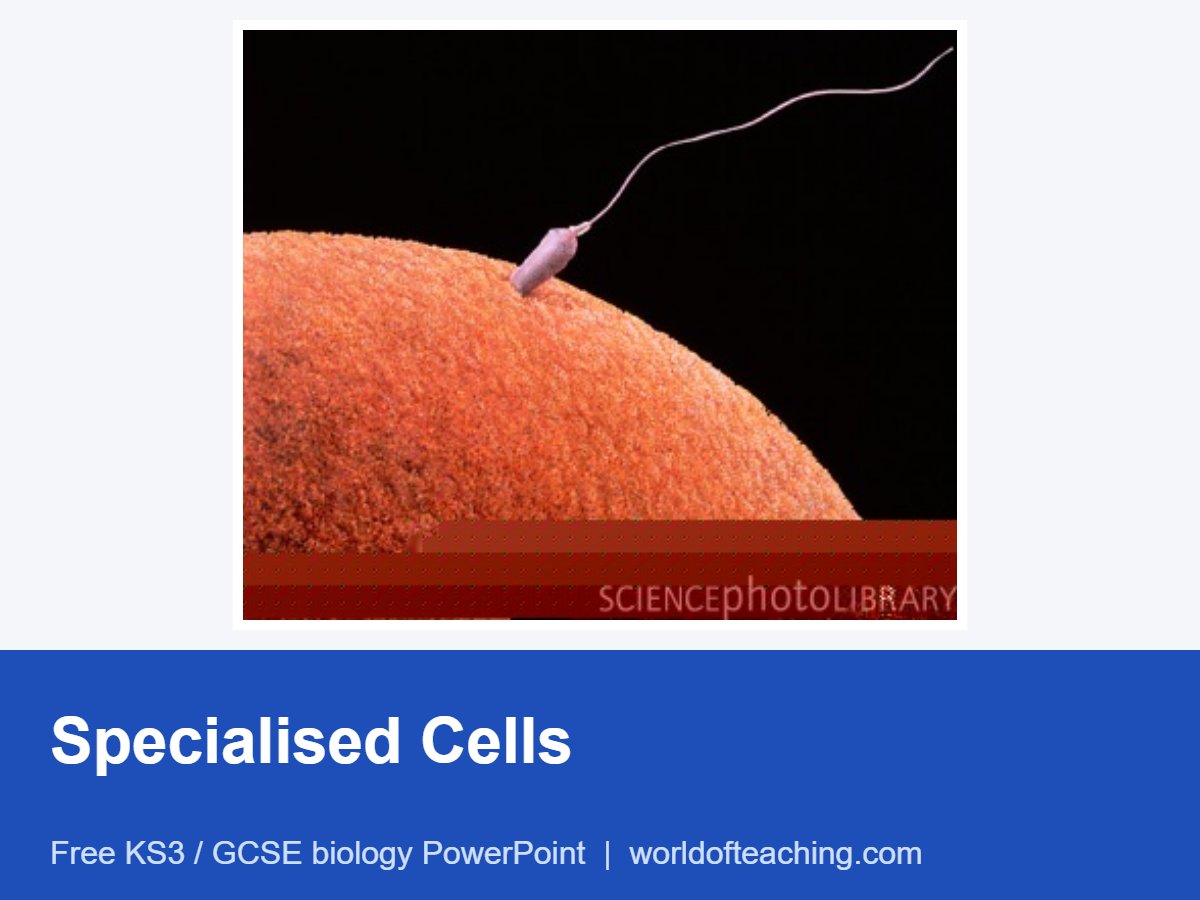
A short picture led introduction to specialised cells. Each slide focuses on one cell type, so it works well as a starter or a labelling and discussion activity where students explain how each cell is adapted to its job.
What this presentation covers
- white blood cells
- sperm cells
- xylem
- red blood cells
- nerve cells
Level: KS3 / GCSE
Slides: 7
Format: PowerPoint (.pptx)
Teaching notes
How to use it. A short, picture led set of 7 slides for KS3 and GCSE Biology (Cell biology in AQA). Each slide shows one cell, so it works well as a starter: show the picture, ask pupils what they think the cell does, then ask them to point to the feature that helps it do that job. It also makes a good revision carousel, with one cell per table.
Key words
- Specialised cell: a cell with a structure adapted to carry out a particular job
- Differentiation: the process by which a cell becomes specialised
- Adaptation: a feature that helps a cell do its job
- Xylem: hollow tubes of dead cells that carry water through a plant
- Haemoglobin: the protein in red blood cells that carries oxygen
Common misconception: “All cells in the body are basically the same.” Most body cells have the same basic parts, but specialised cells have different shapes, sizes and features. A nerve cell can be over a metre long, while a red blood cell has no nucleus at all.
Quick check questions
- How is a sperm cell adapted to swim to the egg?
- Why are nerve cells long with branched ends?
- Give one way a red blood cell is adapted to carry oxygen.
Show answers
- It has a tail to swim and many mitochondria to release the energy it needs.
- To carry impulses over long distances and connect with many other cells.
- Any one of: no nucleus, a biconcave shape for a large surface area, packed with haemoglobin.
Related lessons: The Microscope | Cell Structure revision (premium) | Transport in Plants
New free lessons every week.Follow World of Teaching on Facebook so you never miss one.Follow on Facebook