
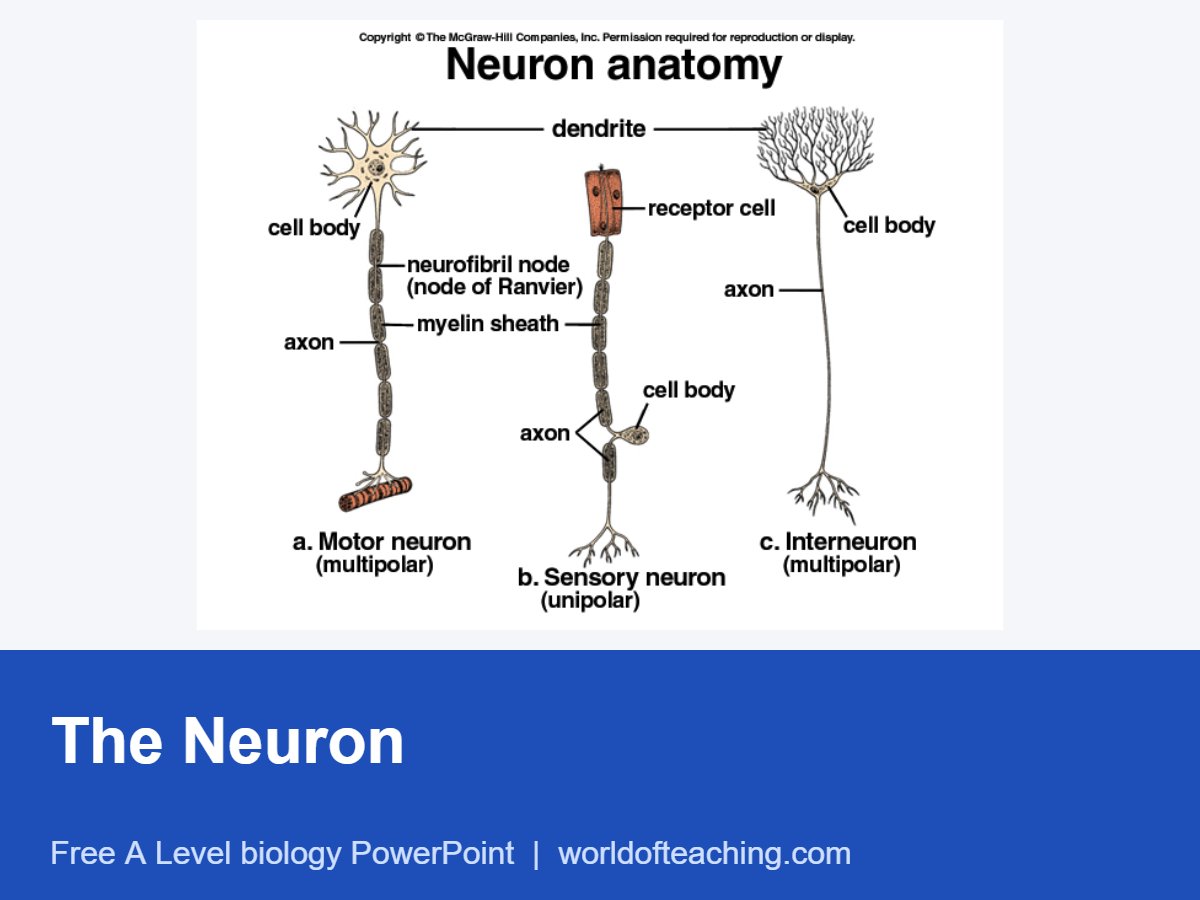
A detailed lesson on how neurons work. It covers neuron structure and types, then explains resting potential, the action potential, depolarisation and repolarisation, the refractory period, saltatory conduction and the all or none response.
What this presentation covers
- neuron structure: dendrites, cell body and axon
- the three types of neuron
- nerves
- resting potential and ion distribution
- the action potential
- depolarisation and repolarisation
- the refractory period
- saltatory conduction and nodes of Ranvier
- the all or none response
Level: A Level
Slides: 22
Format: PowerPoint (.pptx)
Teaching notes
How to use it. A detailed 22 slide A Level lesson (nervous coordination in AQA, OCR and Edexcel A Level Biology). Teach it in two parts: neuron structure and resting potential first, then the action potential. Pupils find it much easier if they sketch and annotate the action potential graph as you go, marking where sodium channels open and where potassium channels open. A simple role play, with pupils acting as sodium and potassium ions crossing a membrane, makes the sequence memorable.
Key words
- Resting potential: the potential difference across the membrane of a neuron at rest, about minus 70 mV
- Action potential: the rapid change in potential difference when a neuron fires
- Depolarisation: sodium ions flooding into the axon, making the inside less negative
- Refractory period: the short time after an action potential when another cannot be triggered
- Saltatory conduction: an impulse jumping between nodes of Ranvier along a myelinated axon
Quick check questions
- Which ions move into the axon during depolarisation?
- Why do myelinated neurons conduct impulses faster?
- What is the purpose of the refractory period?
Show answers
- Sodium ions.
- The impulse jumps from one node of Ranvier to the next (saltatory conduction), so depolarisation only happens at the nodes.
- It makes impulses travel in one direction only and keeps them separate.
Related lessons: The Nervous System | Homeostasis | Krebs Cycle