
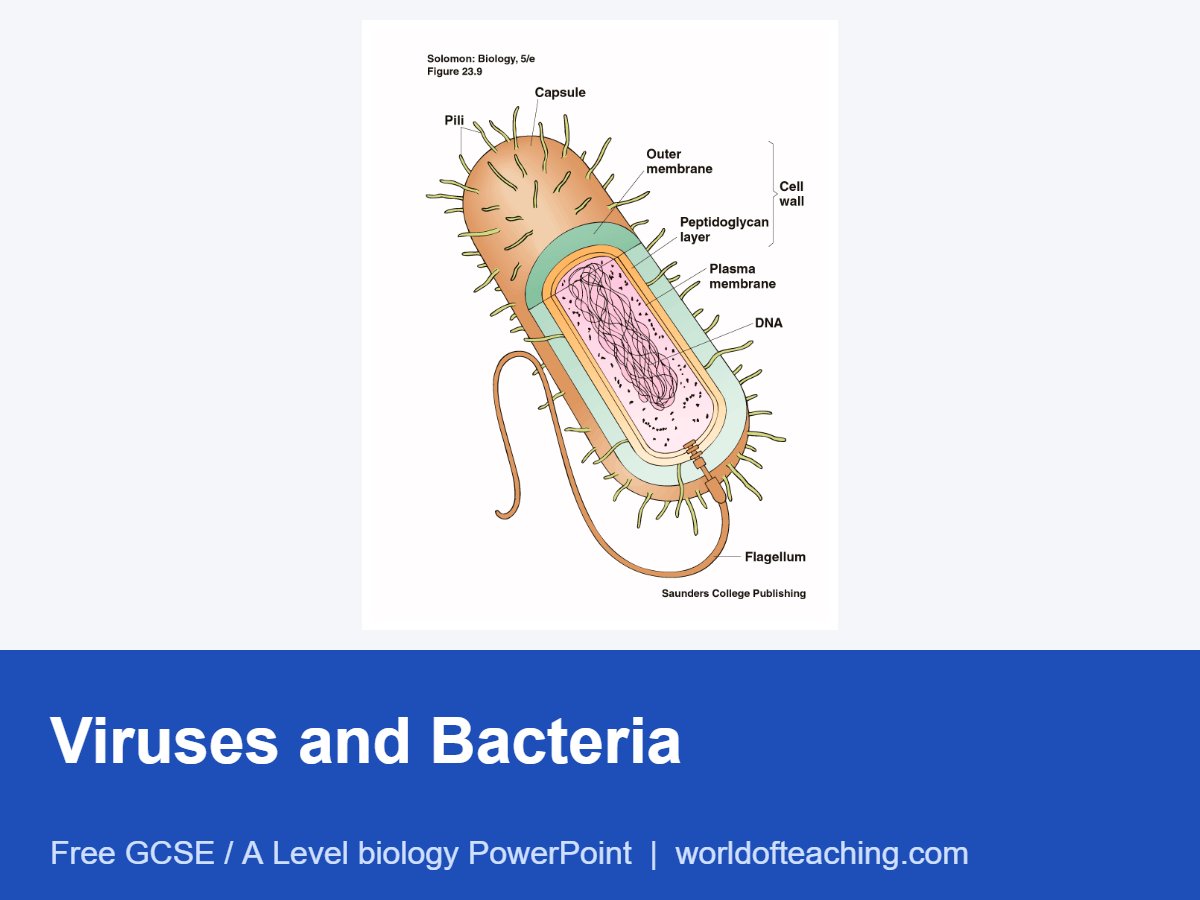
A long and thorough presentation on viruses and bacteria. The first part covers virus structure, bacteriophages, the lytic and lysogenic cycles, vaccines and retroviruses such as HIV. The second part covers prokaryotes, bacterial shapes, Gram staining, how bacteria move, feed, respire and reproduce, and their roles in symbiosis and nitrogen fixation.
What this presentation covers
- what viruses are and their structure
- bacteriophages
- lytic and lysogenic cycles
- vaccines
- retroviruses and HIV
- prokaryotes, eubacteria and archaebacteria
- bacterial shapes and Gram staining
- how bacteria move, get energy and respire
- binary fission, conjugation and spores
- symbiosis and nitrogen fixation
Level: GCSE / A Level
Slides: 39
Format: PowerPoint (.pptx)
Teaching notes
How to use it. At 39 slides this splits neatly into two lessons: viruses first, then bacteria. The virus half and the bacterial reproduction slides suit GCSE (Infection and response in AQA), while Gram staining, the lysogenic cycle and conjugation stretch towards A level. Growing bacteria on agar plates with antibiotic discs is the natural practical to follow on from the second half.
Key words
- Virus: a tiny particle of genetic material in a protein coat that can only reproduce inside a host cell
- Bacteriophage: a virus that infects bacteria
- Lytic cycle: the virus takes over the cell, makes copies of itself and bursts the cell
- Prokaryote: a single celled organism with no nucleus, such as a bacterium
- Binary fission: the way bacteria reproduce, by splitting into two
Quick check questions
- Why can viruses only reproduce inside living cells?
- How do bacteria reproduce?
- A bacterium divides every 20 minutes. How many bacteria will there be after 2 hours, starting from one?
Show answers
- They do not have the cell machinery to make copies of themselves, so they use the host cell’s.
- By binary fission: one cell splits into two.
- 64, because 2 hours is 6 divisions and 2 to the power 6 is 64.
Related lessons: The Immune System | Penicillin | Cell Structure revision (premium)