
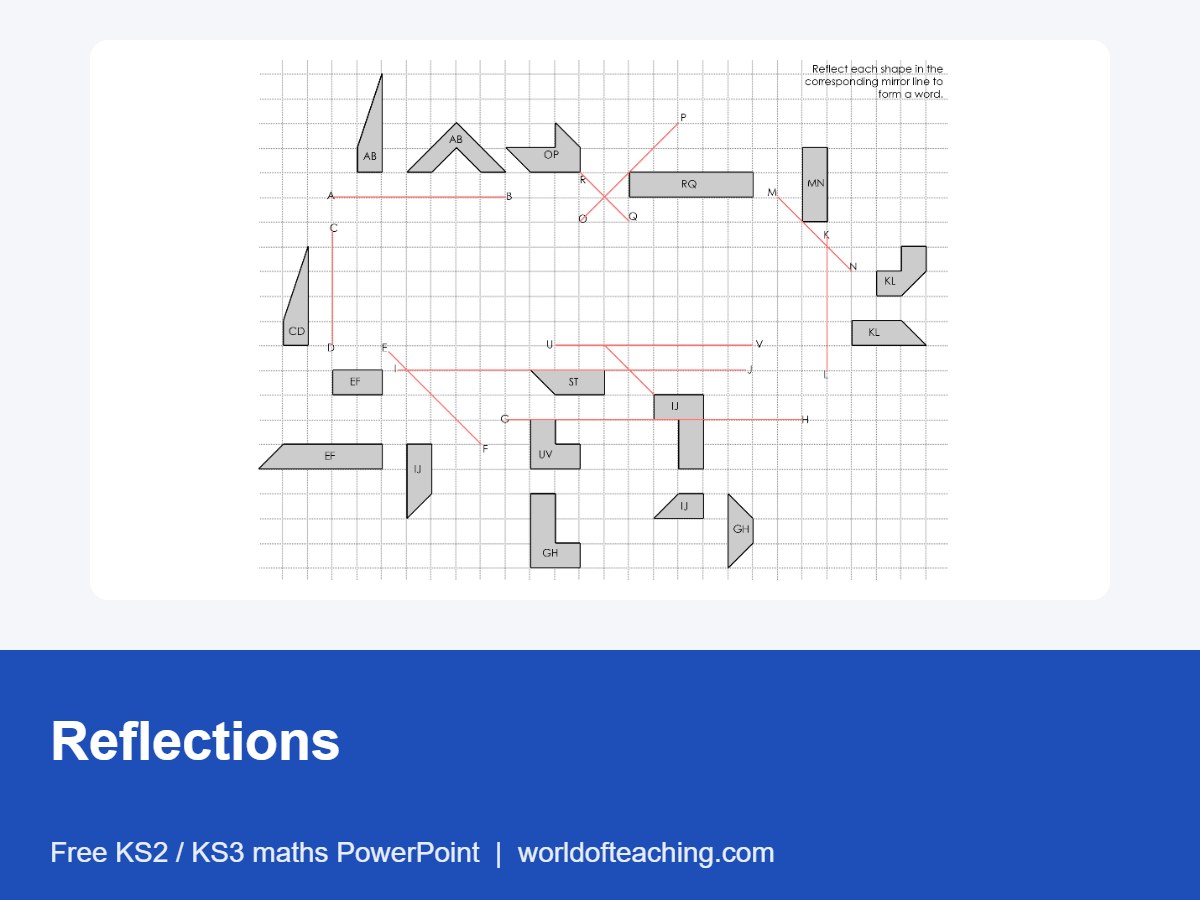
A starter style lesson on reflection. Students reflect each shape in its mirror line to work out which letter it makes, then move on to reflecting shapes on a worksheet.
What this presentation covers
- reflecting a shape in a mirror line
- what letter does each reflection make?
- reflecting shapes on a worksheet
Level: KS2 / KS3
Slides: 10
Format: PowerPoint (.pptx)
Contributed by: Kausar Khan
Teaching notes
How to use it. A fun 10 slide starter for KS2 and KS3 where pupils reflect shapes to reveal letters. Small mirrors make it very hands on: pupils can check each prediction by placing a mirror on the mirror line. Follow with the worksheet task on squared paper, starting with vertical and horizontal mirror lines before moving on to diagonal lines such as y = x for older pupils.
Key words
- Reflection: a transformation that flips a shape over a mirror line
- Mirror line: the line a shape is reflected in, also called the line of reflection
- Image: the new shape after a transformation
- Object: the original shape before it is transformed
- Congruent: exactly the same shape and size; a reflection is always congruent to the original
Common misconception: “When reflecting, just slide the shape across to the other side of the mirror line.” Each point must end up the same distance from the mirror line on the opposite side, so the shape is flipped, not just moved. Pupils should count squares from the line for each corner.
Quick check questions
- Does a reflection change the size of a shape?
- A point is 3 squares to the left of a vertical mirror line. Where is its image?
- Which capital letters look the same when reflected in a vertical line down their middle? Give two.
Show answers
- No, the image is congruent to the object.
- 3 squares to the right of the mirror line.
- Any two of A, H, I, M, O, T, U, V, W, X, Y.
Related lessons: Lines and Angles | Classifying Triangles | Gradient of a Line
New free lessons every week.Follow World of Teaching on Facebook so you never miss one.Follow on Facebook