
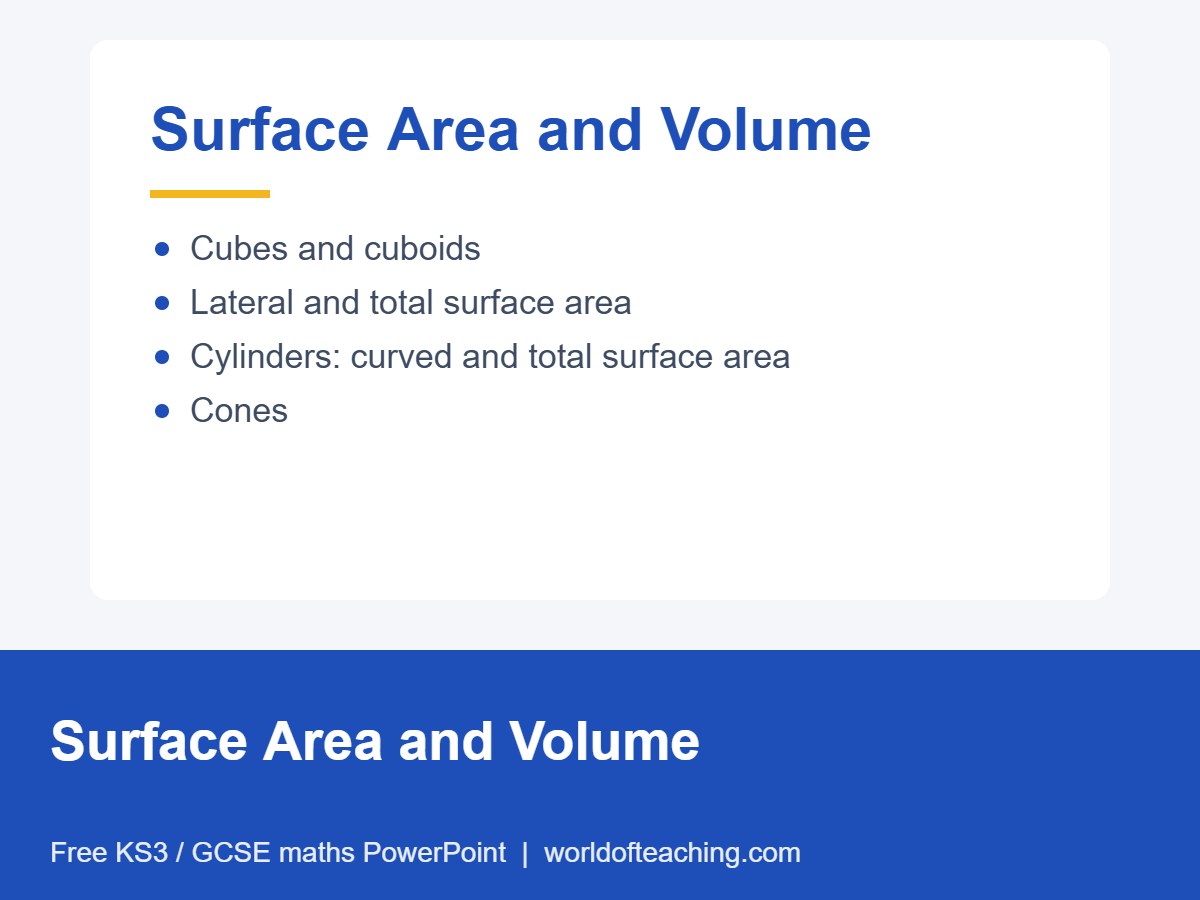
A lesson on the surface area and volume of 3D solids. For each solid it gives a definition and a labelled diagram with the formulas for surface area and volume, covering cubes, cuboids, cylinders, cones, spheres and hemispheres.
What this presentation covers
- cubes and cuboids
- lateral and total surface area
- cylinders: curved and total surface area
- cones
- spheres
- hemispheres
- volume of each solid
Level: KS3 / GCSE
Slides: 24
Format: PowerPoint (.pptx)
Contributed by: Jennifer Jasensky
Teaching notes
How to use it. A 24 slide reference style lesson for KS3 and GCSE, with a labelled diagram and formula for each solid. It works well taught over two or three lessons, starting with cubes and cuboids and moving to cylinders, cones and spheres. Real objects help a great deal: a cereal box opened out into its net shows exactly why the surface area is the sum of the faces, and a tin can shows the curved surface of a cylinder unrolling into a rectangle.
Key words
- Surface area: the total area of all the faces of a 3D shape, measured in square units
- Volume: the amount of space inside a 3D shape, measured in cubic units
- Net: a flat shape that folds up to make a 3D solid
- Curved surface area: the area of the curved part of a cylinder, cone or sphere
- Hemisphere: half of a sphere
Quick check questions
- Find the volume of a cuboid 5 cm by 4 cm by 3 cm.
- Find the surface area of a cube with edges of 2 cm.
- A cylinder has radius 3 cm and height 10 cm. Find its volume in terms of pi.
Show answers
- 60 cm³
- 24 cm², because it has 6 faces each of 4 cm².
- 90π cm³, because π × 3² × 10 = 90π.
Related lessons: Volume of a Cylinder | Perimeter and Area | Area and Circumference of Circles