
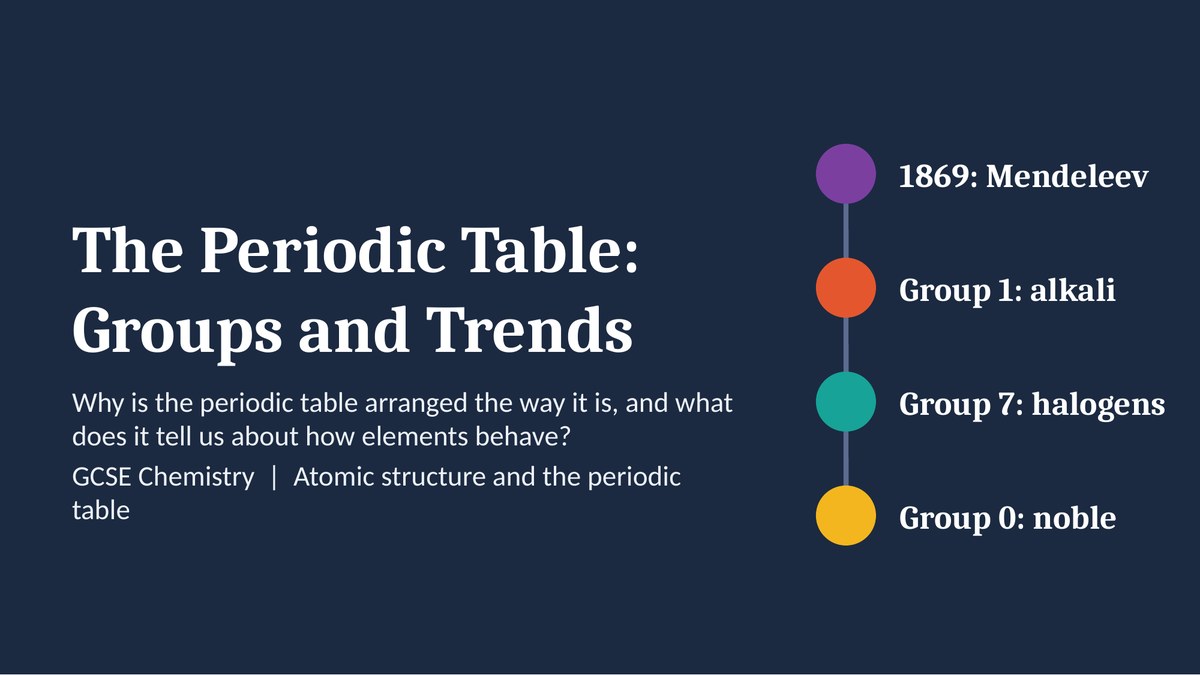
A complete, ready to teach GCSE Chemistry lesson on the periodic table. Students find out how Mendeleev arranged the elements and why he left gaps, learn to read groups and periods from electron arrangements, and explain the trends in the alkali metals, the halogens and the noble gases. Clear, editable diagrams throughout, including a colour coded periodic table and shell diagrams.
- 31 slides
- About 60 to 70 minutes
- All answers included
- Teacher notes on every slide
- Fully editable
Download this PowerPoint free (.pptx)
What the lesson covers
- Learning objectives at three levels: must, should and could.
- Warm up recap quiz on atomic structure, and key words including group, period, alkali metal, halogen and noble gas.
- The big picture: a timeline from early lists of elements to the modern table ordered by atomic number.
- Dmitri Mendeleev: how he ordered the elements, left gaps and made predictions, with a public domain portrait.
- Then and now: Mendeleev’s table compared with the modern periodic table.
- Groups and periods: a colour coded table of the first four periods showing metals, non metals and noble gases.
- Position and electrons: sodium and chlorine shell diagrams showing how group and period come from electron arrangement.
- Group 1, Group 7 and Group 0: properties, reactions, uses and the trends in reactivity, explained using electrons.
- Three practice quizzes with answers.
- Exam practice: an AQA style 6 mark question on Group 1 reactivity, a mark scheme, a model answer, common mistakes and an exit ticket.
Who it is for
GCSE Chemistry and Combined Science students on AQA, Edexcel, OCR or WJEC, in Year 9, 10 or 11, and useful for revision before mocks. It follows on from our premium Atomic Structure lesson.
Download this PowerPoint free (.pptx)
New free lessons every week.Follow World of Teaching on Facebook so you never miss one.Follow on Facebook
More resources
Browse all premium PowerPoints or find more teacher made slides in our free chemistry PowerPoints.