
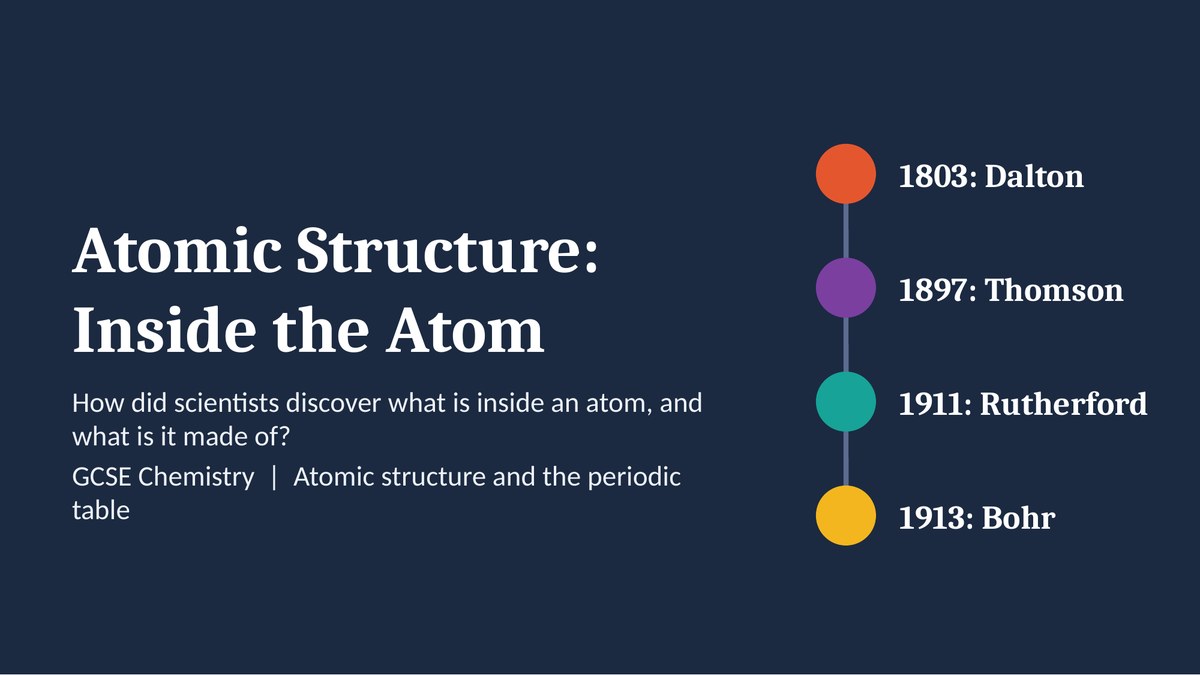
A complete, ready to teach GCSE Chemistry lesson on atomic structure. Students follow how the model of the atom developed from Dalton’s solid spheres to Bohr’s shells, see how the gold foil experiment revealed the nucleus, and learn to work out the protons, neutrons and electrons in any atom. Clear, editable diagrams throughout, with portraits of the five scientists who shaped the model.
- 31 slides
- About 60 to 70 minutes
- All answers included
- Teacher notes on every slide
- Fully editable
Download this PowerPoint free (.pptx)
What the lesson covers
- Learning objectives at three levels: must, should and could.
- Warm up quiz with answers, and key words including nucleus, atomic number, mass number and isotope.
- The big picture: a timeline from Dalton in 1803 to Chadwick’s discovery of the neutron in 1932.
- The scientists: Dalton, Thomson, Rutherford, Bohr and Chadwick, with public domain portraits.
- Four models of the atom drawn side by side: solid sphere, plum pudding, nuclear and shell models.
- The gold foil experiment: a diagram of alpha particle scattering, with each observation linked to its conclusion.
- Inside the atom: a labelled atom, the charge and mass of protons, neutrons and electrons, and the size of an atom.
- Atomic number and mass number: working out the particles in an atom, with a practice quiz and answers.
- Isotopes and electron shells: carbon 12 and carbon 14 drawn side by side, and shell diagrams with a practice quiz.
- Exam practice: an AQA style 6 mark question on the development of the model, a mark scheme, a model answer, common mistakes and an exit ticket.
Who it is for
GCSE Chemistry and Combined Science students on AQA, Edexcel, OCR or WJEC, in Year 9, 10 or 11, and useful for revision before mocks. It leads straight into our premium Periodic Table lesson, and pairs well with our AQA GCSE Biology revision PowerPoints.
Download this PowerPoint free (.pptx)
More resources
Browse all premium PowerPoints or find more teacher made slides in our free chemistry PowerPoints.