
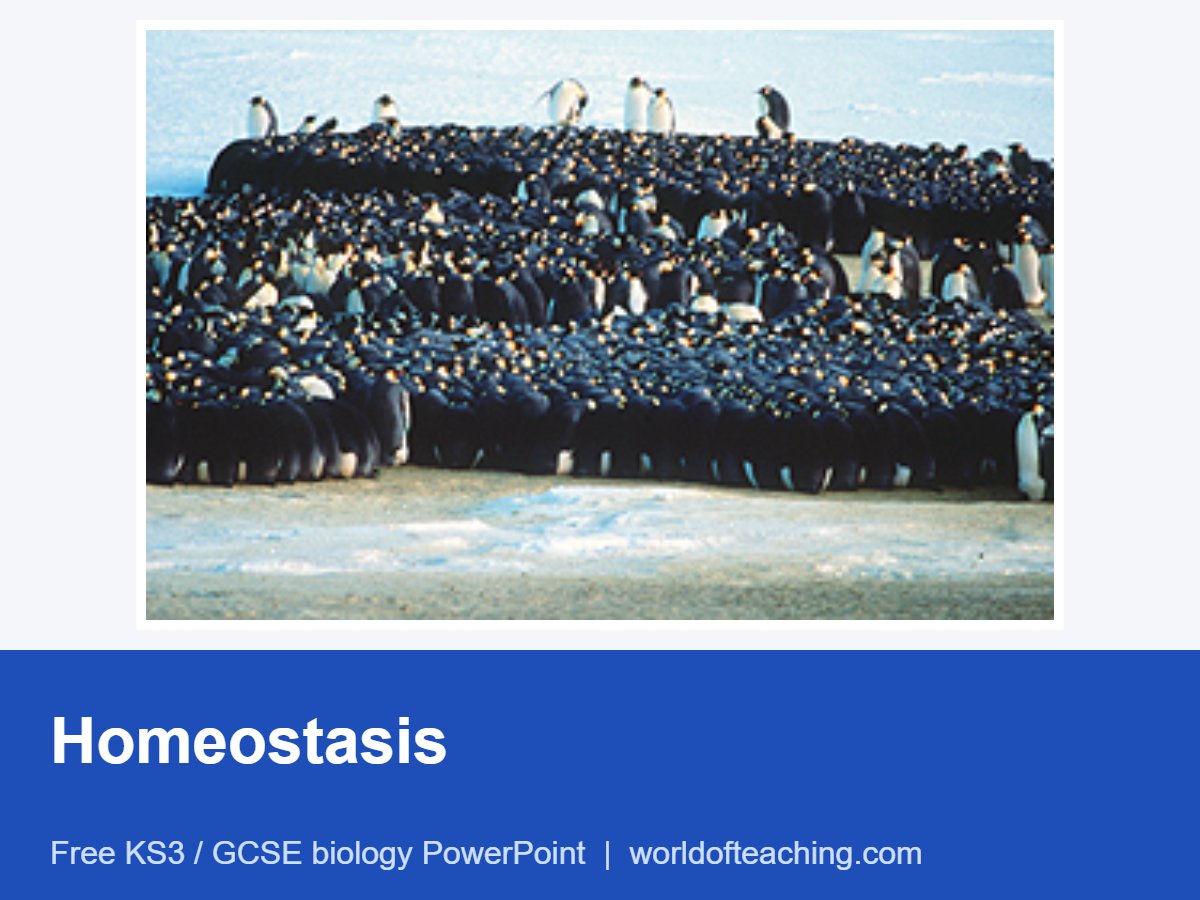
A full lesson on homeostasis, starting with a glossary of key words. It covers control of body temperature, including surface area to volume ratio, sweating, vasodilation and vasoconstriction, then blood glucose control by insulin and glucagon, diabetes, and how the kidneys control water levels.
What this presentation covers
- what homeostasis means
- surface area to volume ratio and heat loss
- sweating, vasodilation, vasoconstriction and hairs standing up
- insulin, glucagon and glycogen
- diabetes and blood glucose graphs
- how the kidneys filter blood
- reabsorption of glucose, water and ions
- urea and urine production
Level: KS3 / GCSE
Slides: 36
Format: PowerPoint (.pptx)
Teaching notes
How to use it. At 36 slides this is best taught over two lessons: temperature control in the first, then blood glucose and the kidneys in the second. It fits KS3 and GCSE Biology (Homeostasis and response in AQA). The diabetes graphs are a great data task, and a simple flow chart for each control system (change, detected by, response, back to normal) helps pupils see that they all follow the same pattern.
Key words
- Homeostasis: keeping conditions inside the body constant
- Vasodilation: blood vessels near the skin widening so more heat is lost
- Vasoconstriction: blood vessels near the skin narrowing so less heat is lost
- Insulin: a hormone from the pancreas that lowers blood glucose
- Glucagon: a hormone from the pancreas that raises blood glucose
Quick check questions
- Why does sweating cool the body down?
- What does insulin cause the liver to do?
- Why do small animals lose heat faster than large ones?
Show answers
- Water in the sweat evaporates from the skin, and that takes heat energy away from the body.
- Take up glucose from the blood and store it as glycogen.
- They have a larger surface area to volume ratio.
Related lessons: The Kidneys | The Nervous System | Enzymes