
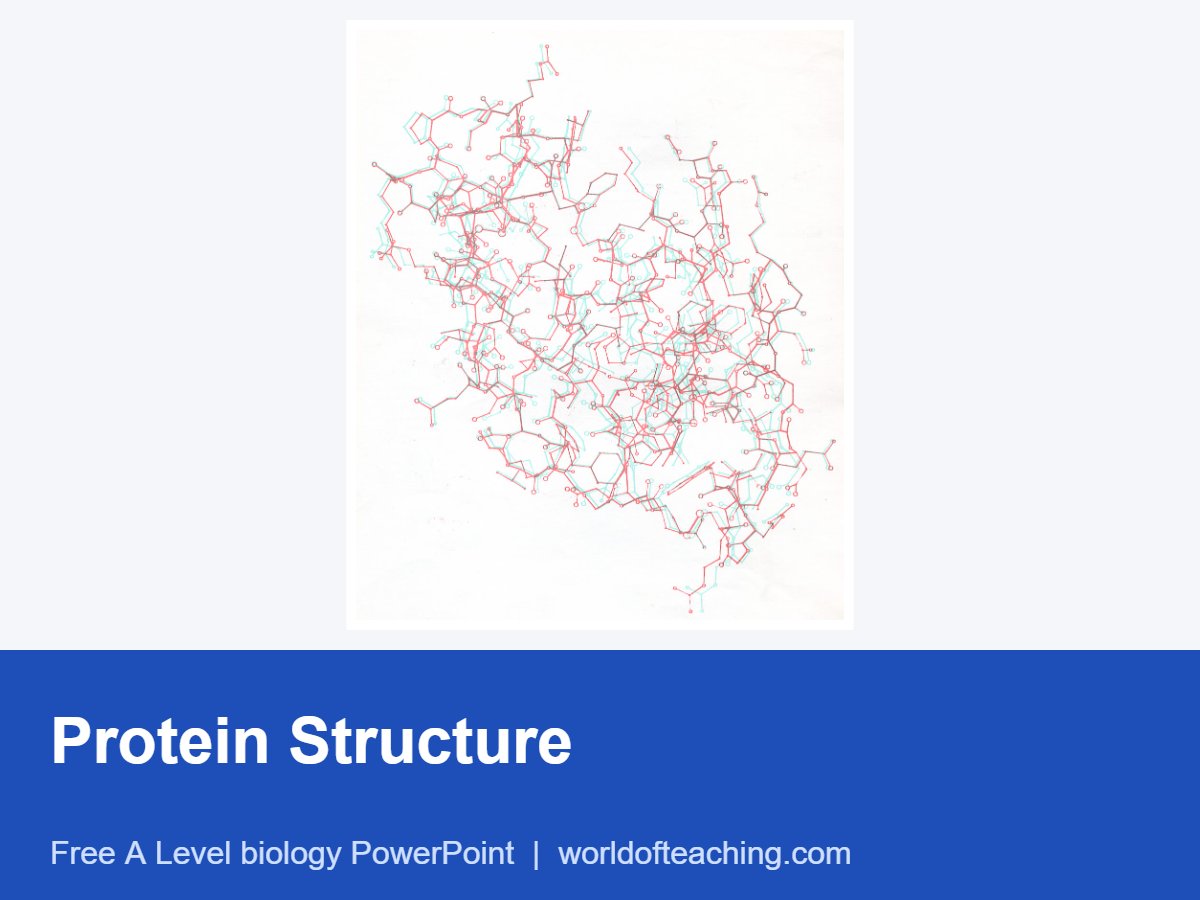
A detailed, image rich lesson on protein structure, with some slides designed to be viewed in 3D with red and cyan glasses. It builds up from amino acids and peptide bonds to primary, secondary and tertiary structure, using real proteins such as insulin, collagen, myoglobin and lysozyme as examples.
What this presentation covers
- amino acids and the 20 naturally occurring types
- peptide bonds, condensation and hydrolysis
- primary structure (pig insulin)
- secondary structure: the alpha helix and beta pleated sheet
- collagen as a fibrous protein
- tertiary structure, myoglobin and the haem group
- globular proteins and enzymes such as lysozyme and chymotrypsin
Level: A Level
Slides: 22
Format: PowerPoint (.pptx)
Teaching notes
How to use it. Pitched at A level Biology (Biological molecules). If you have red and cyan glasses, the 3D slides are a memorable way to see the alpha helix and the folded shape of myoglobin. Building a short chain of amino acids from paper clips or poppit beads, then folding it, helps pupils see how primary structure decides the final shape.
Key words
- Amino acid: the monomer that proteins are made from; there are 20 different types
- Peptide bond: the bond that joins two amino acids, formed by a condensation reaction
- Primary structure: the order of amino acids in a polypeptide chain
- Secondary structure: the alpha helix or beta pleated sheet, held by hydrogen bonds
- Tertiary structure: the final folded 3D shape of a polypeptide
Quick check questions
- What type of reaction joins two amino acids?
- Name two bonds that hold the tertiary structure together.
- How is a fibrous protein like collagen different from a globular protein like myoglobin?
Show answers
- A condensation reaction, which releases a molecule of water.
- Any two of: disulfide bridges, ionic bonds, hydrogen bonds and hydrophobic interactions.
- Fibrous proteins are long, strong and insoluble, with structural roles; globular proteins are compact, soluble and often have roles in reactions or transport.
Related lessons: Enzymes | Protein Synthesis | DNA Structure