
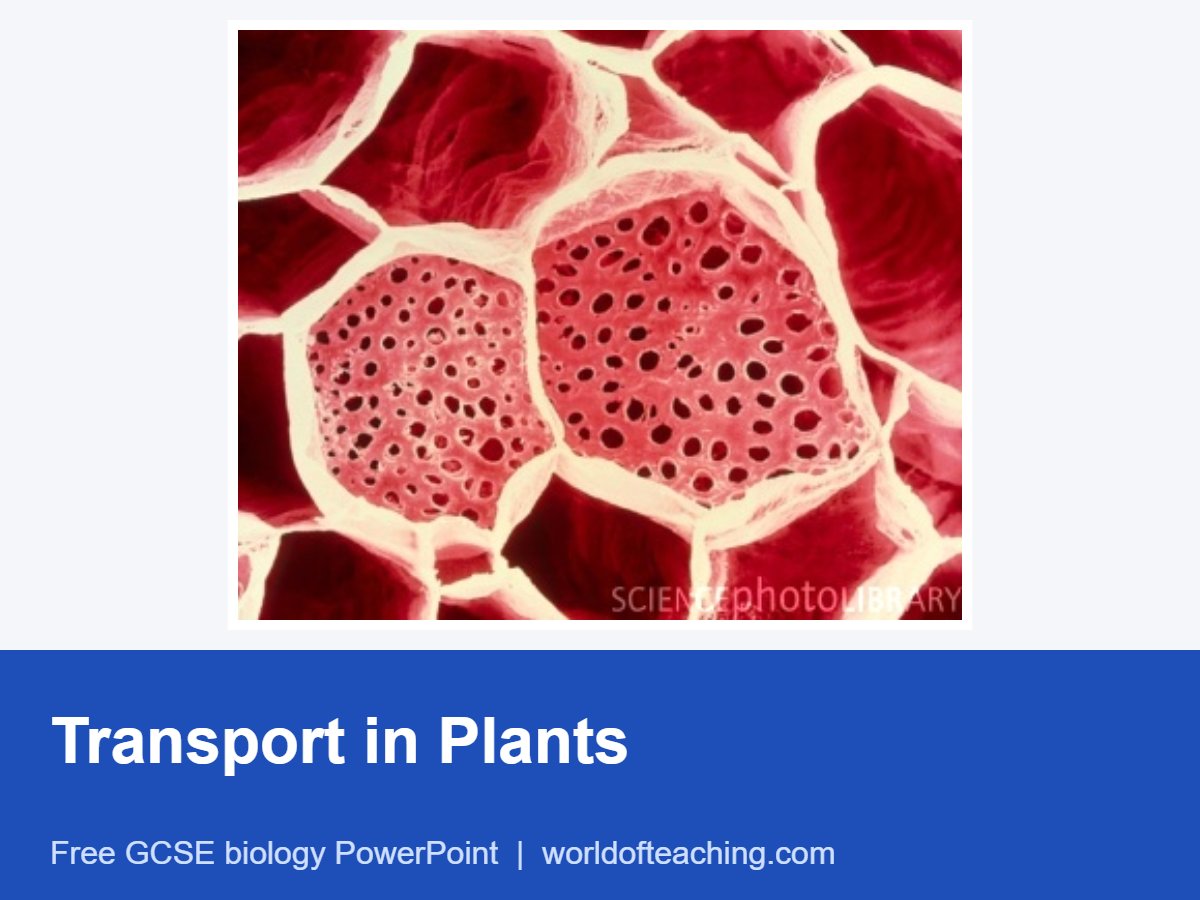
A focused lesson on how plants move water and sugar. It explains why plants need a transport system, compares the structure and job of xylem and phloem, and shows how stomata control gas exchange and water loss.
What this presentation covers
- why plants need transport systems
- xylem: structure and water transport
- phloem: sugar transport and companion cells
- stomata and guard cells
- gas exchange and water loss
Level: GCSE
Slides: 9
Format: PowerPoint (.pptx)
Teaching notes
How to use it. This lesson fits the plant tissues part of GCSE Biology (Organisation in AQA). It works well alongside a quick practical: stand a stick of celery in coloured water for an hour and pupils can see the xylem stained in cross section, or paint clear nail varnish on a leaf and peel it off to count stomata under a microscope.
Key words
- Xylem: dead, hollow cells that carry water and mineral ions up from the roots
- Phloem: living cells that carry dissolved sugars around the plant
- Translocation: the movement of dissolved sugars through the phloem
- Transpiration: the loss of water vapour from the leaves, which pulls water up the xylem
- Stomata: tiny pores in the leaf surface, opened and closed by guard cells
Common misconception: “Xylem and phloem do the same job, or xylem carries food.” Xylem carries water and minerals upwards only. Phloem carries sugars both up and down, wherever they are needed. A simple memory aid: phloem carries food.
Quick check questions
- Which tissue carries water and mineral ions?
- What is translocation?
- How do guard cells reduce water loss on a hot, dry day?
Show answers
- Xylem.
- The movement of dissolved sugars through the phloem.
- They close the stomata, which reduces transpiration.
Related lessons: Photosynthesis | Diffusion and Osmosis | Osmosis revision (premium)
New free lessons every week.Follow World of Teaching on Facebook so you never miss one.Follow on Facebook