
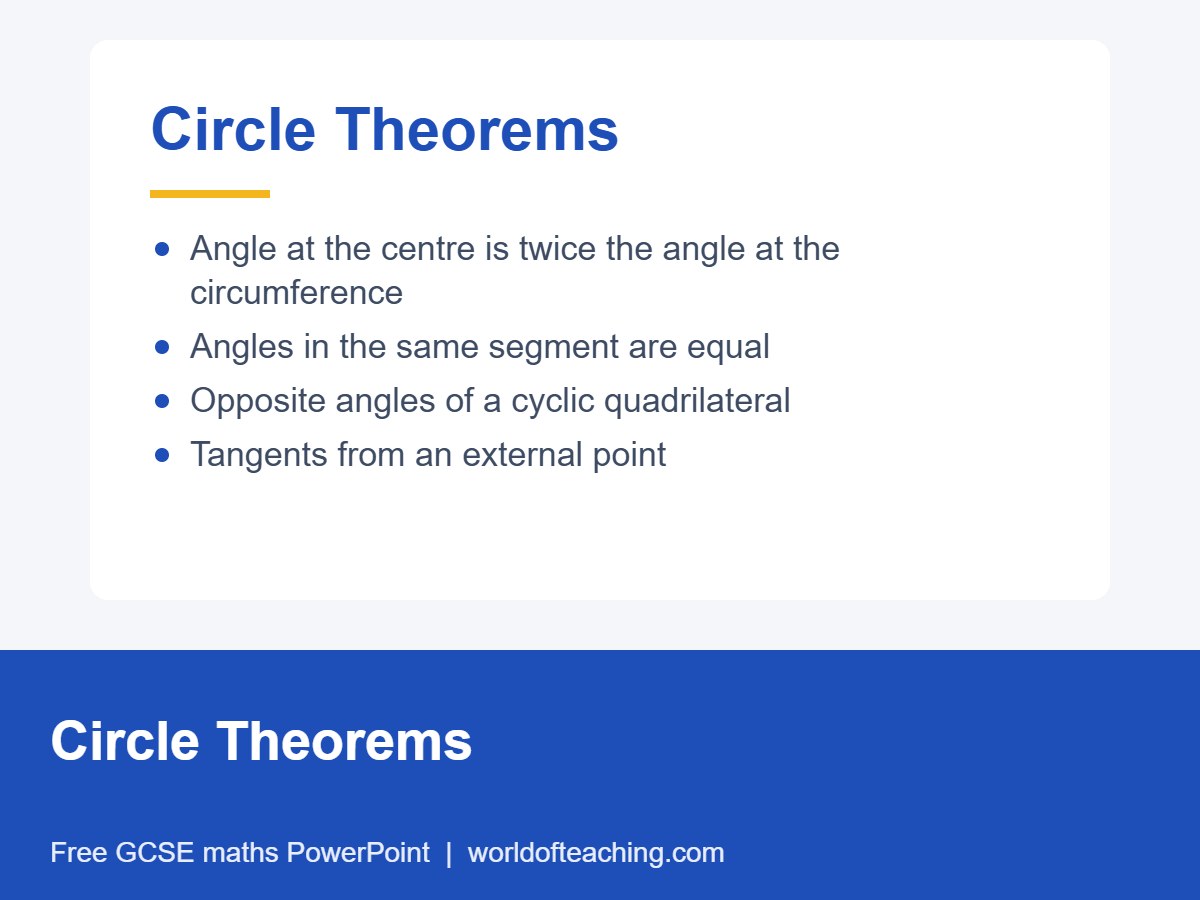
A visual summary of the main circle theorems, with one diagram per slide: the angle at the centre is twice the angle at the circumference, angles in the same segment are equal, opposite angles in a cyclic quadrilateral add up to 180 degrees, tangents from a point are equal, the alternate segment theorem and the angle in a semicircle.
What this presentation covers
- angle at the centre is twice the angle at the circumference
- angles in the same segment are equal
- opposite angles of a cyclic quadrilateral
- tangents from an external point
- the alternate segment theorem
- the angle in a semicircle is 90 degrees
Level: GCSE
Slides: 8
Format: PowerPoint (.pptx)
Contributed by: Jim Randle
Teaching notes
How to use it. An 8 slide visual summary, one theorem per slide, for GCSE higher tier. It works best as a revision aid or to introduce the theorems, followed by plenty of practice. Give pupils a blank circle template and ask them to draw and label each theorem as you go, so they build their own reference sheet. In exam answers pupils must state the theorem in words, so have them practise writing each reason in full.
Key words
- Circumference: the distance around the edge of a circle, or the edge itself
- Chord: a straight line joining two points on the circumference
- Tangent: a straight line that touches the circle at exactly one point
- Cyclic quadrilateral: a four sided shape with all four corners on the circumference
- Segment: the region between a chord and the arc it cuts off
Quick check questions
- The angle at the centre is 110 degrees. What is the angle at the circumference standing on the same arc?
- One angle in a cyclic quadrilateral is 72 degrees. What is the opposite angle?
- What is the angle between a tangent and the radius at the point of contact?
Show answers
- 55 degrees, because the angle at the centre is twice the angle at the circumference.
- 108 degrees, because opposite angles add up to 180 degrees.
- 90 degrees.
Related lessons: Area and Circumference of Circles | Lines and Angles | Sine and Cosine Rules