
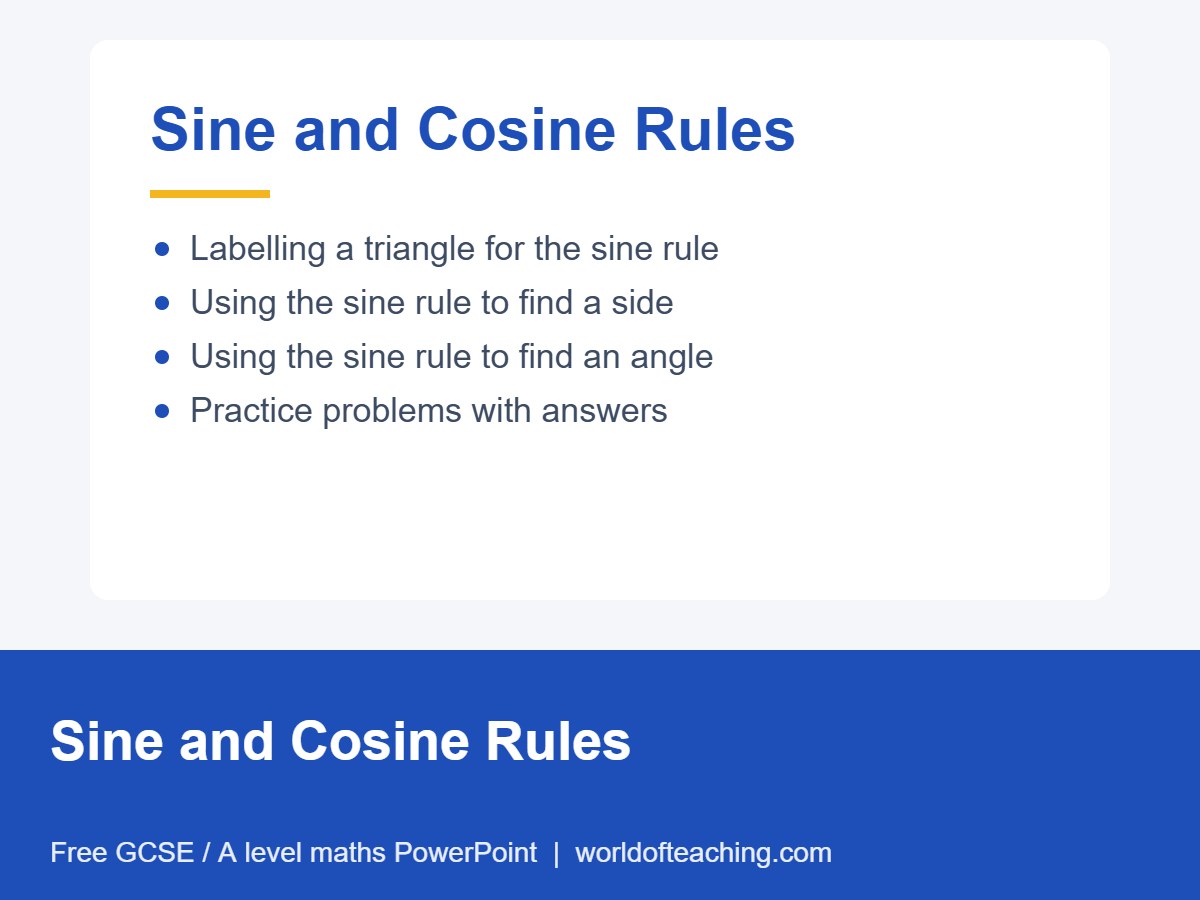
A lesson on solving non right angled triangles. It shows which form of the sine rule to use to find a side or an angle, works through examples and three practice problems with answers, then introduces the cosine rule for finding a side and for finding an angle when all three sides are known.
What this presentation covers
- labelling a triangle for the sine rule
- using the sine rule to find a side
- using the sine rule to find an angle
- practice problems with answers
- when the sine rule is not enough
- the cosine rule
- finding an angle from three sides
Level: GCSE / A level
Slides: 17
Format: PowerPoint (.pptx)
Contributed by: Andrew Godin
Teaching notes
How to use it. A 17 slide lesson for GCSE higher tier and A Level, best taught once pupils are confident with SOHCAHTOA. The key skill is choosing the right rule, so after the worked examples give pupils a set of triangles and ask them only to decide which rule they would use and why, before they calculate anything. The three practice problems with answers make a good independent task, and a quick check that the calculator is in degree mode saves a lot of wrong answers.
Key words
- Sine rule: a/sin A = b/sin B = c/sin C, used when you know a side and its opposite angle
- Cosine rule: a² = b² + c² minus 2bc cos A, used with two sides and the included angle, or with all three sides
- Included angle: the angle between two given sides
- Opposite side: the side directly across from a given angle
- Non right angled triangle: a triangle with no 90 degree angle, where SOHCAHTOA cannot be used directly
Quick check questions
- You know two sides and the angle between them. Which rule finds the third side?
- You know two angles and one side. Which rule should you use?
- What must you check on your calculator before using either rule?
Show answers
- The cosine rule.
- The sine rule.
- That it is in degree mode.
Related lessons: Trigonometry SOHCAHTOA (full lesson) | Pythagoras’ Theorem | Circle Theorems