
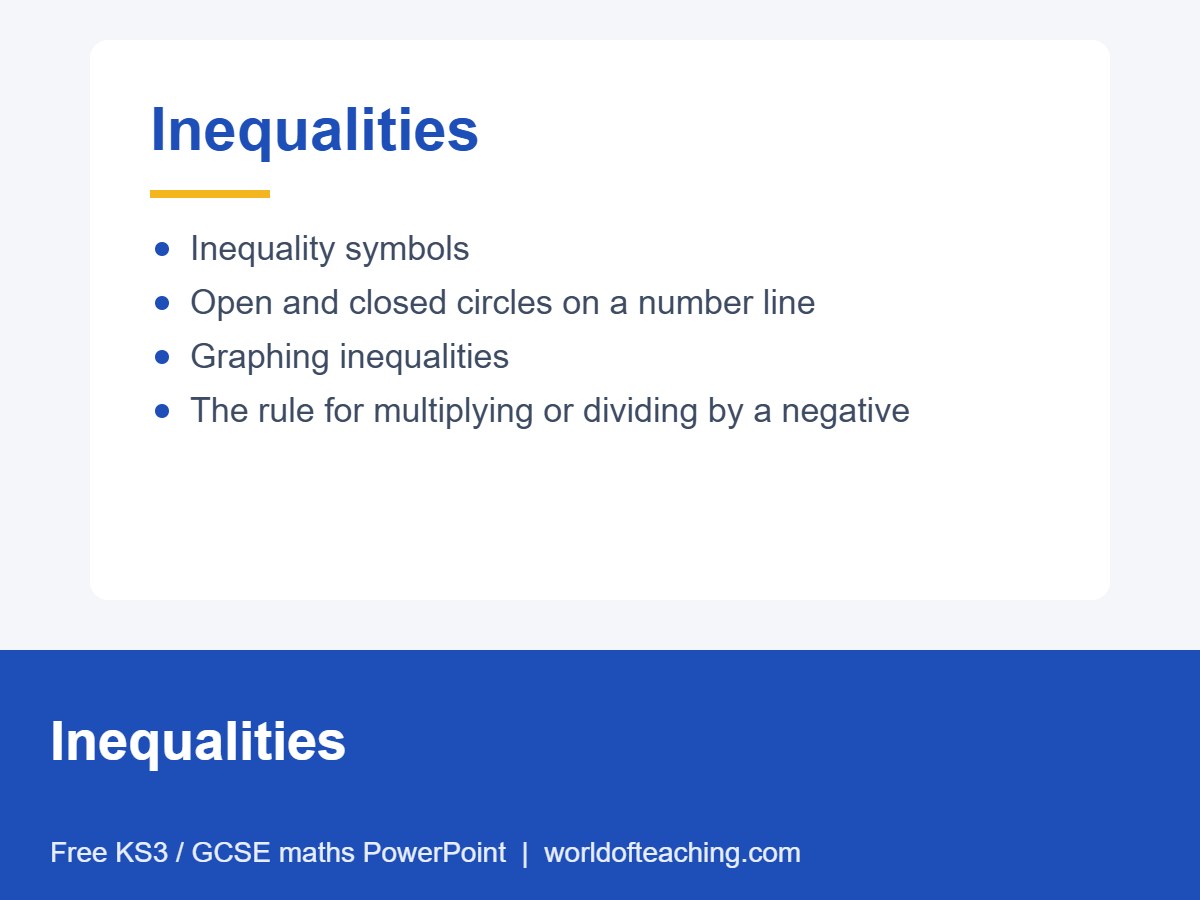
A lesson on graphing and solving inequalities. It introduces the inequality symbols, shows when to use an open or closed circle on a number line, and works through one step and two step inequalities, including the rule for reversing the sign when multiplying or dividing by a negative number.
What this presentation covers
- inequality symbols
- open and closed circles on a number line
- graphing inequalities
- the rule for multiplying or dividing by a negative
- solving one step inequalities
- solving two step inequalities
- practice questions
Level: KS3 / GCSE
Slides: 10
Format: PowerPoint (.pptx)
Contributed by: Debbie Taylor
Teaching notes
How to use it. Suits KS3 and GCSE Foundation. Pupils who are secure with solving equations pick this up quickly, so start by solving a simple equation and then change the equals sign to an inequality. Mini whiteboards work well for the number line questions, because you can see straight away who is using open and closed circles correctly.
Key words
- Inequality: a statement that one amount is bigger or smaller than another
- Open circle: used on a number line when the end number is not included (< or >)
- Closed circle: used on a number line when the end number is included (≤ or ≥)
- Integer: a whole number, which can be positive, negative or zero
- Solution set: all the values that make an inequality true
Quick check questions
- Solve 3x + 1 < 16.
- List the integers that satisfy 2 < n ≤ 5.
- Would you draw x ≥ 4 with an open or a closed circle?
Show answers
- x < 5.
- 3, 4 and 5.
- A closed circle, because 4 is included.
Related lessons: Linear Equations | Solving Multi Step Equations | Order of Operations