
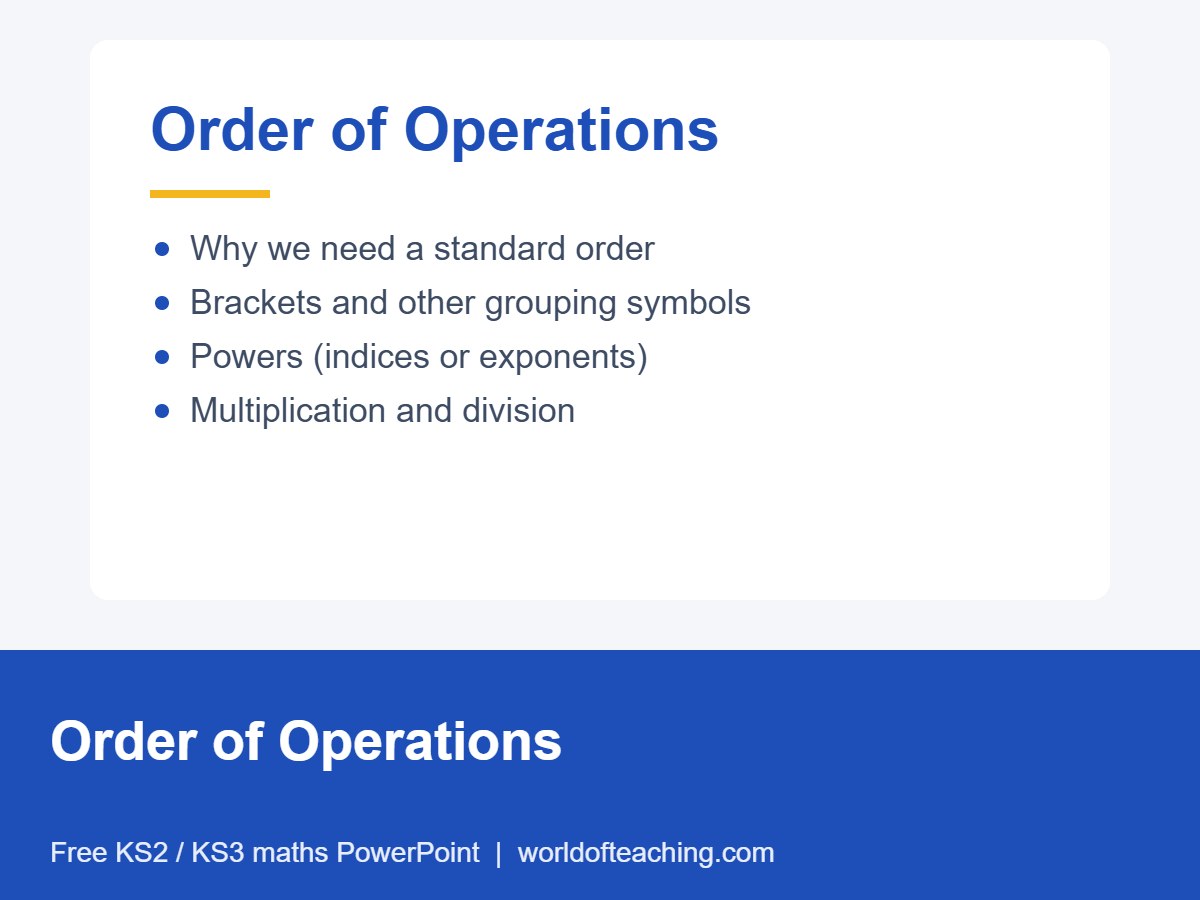
An introduction to the order of operations (BIDMAS or PEMDAS). It shows why a calculation such as 8 + 3 × 4 needs an agreed rule, sets out the order for brackets, powers, multiplication and division, and addition and subtraction, and gives a memory aid for remembering it.
What this presentation covers
- why we need a standard order
- brackets and other grouping symbols
- powers (indices or exponents)
- multiplication and division
- addition and subtraction
- the Please Excuse My Dear Aunt Sally memory aid
Level: KS2 / KS3
Slides: 9
Format: PowerPoint (.pptx)
Contributed by: Robert Clutter
Teaching notes
How to use it. A short 9 slide introduction that works well as a starter for KS2 and KS3. Before showing the slides, write 8 + 3 × 4 on the board and ask the class for the answer: you will usually get both 44 and 20, which shows exactly why an agreed order is needed. The slides use the American PEMDAS memory aid, so tell pupils that BIDMAS (brackets, indices, division, multiplication, addition, subtraction) means the same thing, then check the order on a scientific calculator.
Key words
- BIDMAS: brackets, indices, division and multiplication, addition and subtraction, the order used in the UK
- PEMDAS: parentheses, exponents, multiplication and division, addition and subtraction, the same rule as used in the USA
- Brackets: symbols that group part of a calculation so it is worked out first
- Indices: powers such as squared or cubed, also called exponents
- Operation: a mathematical process such as adding, subtracting, multiplying or dividing
Quick check questions
- Work out 8 + 3 × 4.
- Work out (5 + 3) × 2.
- Work out 2 + 3².
Show answers
- 20, because the multiplication is done first: 3 × 4 = 12, then 8 + 12 = 20.
- 16, because the brackets are worked out first.
- 11, because the power comes before the addition: 3² = 9, then 2 + 9 = 11.
Related lessons: Simplifying Expressions | Squares and Square Roots | Laws of Indices