
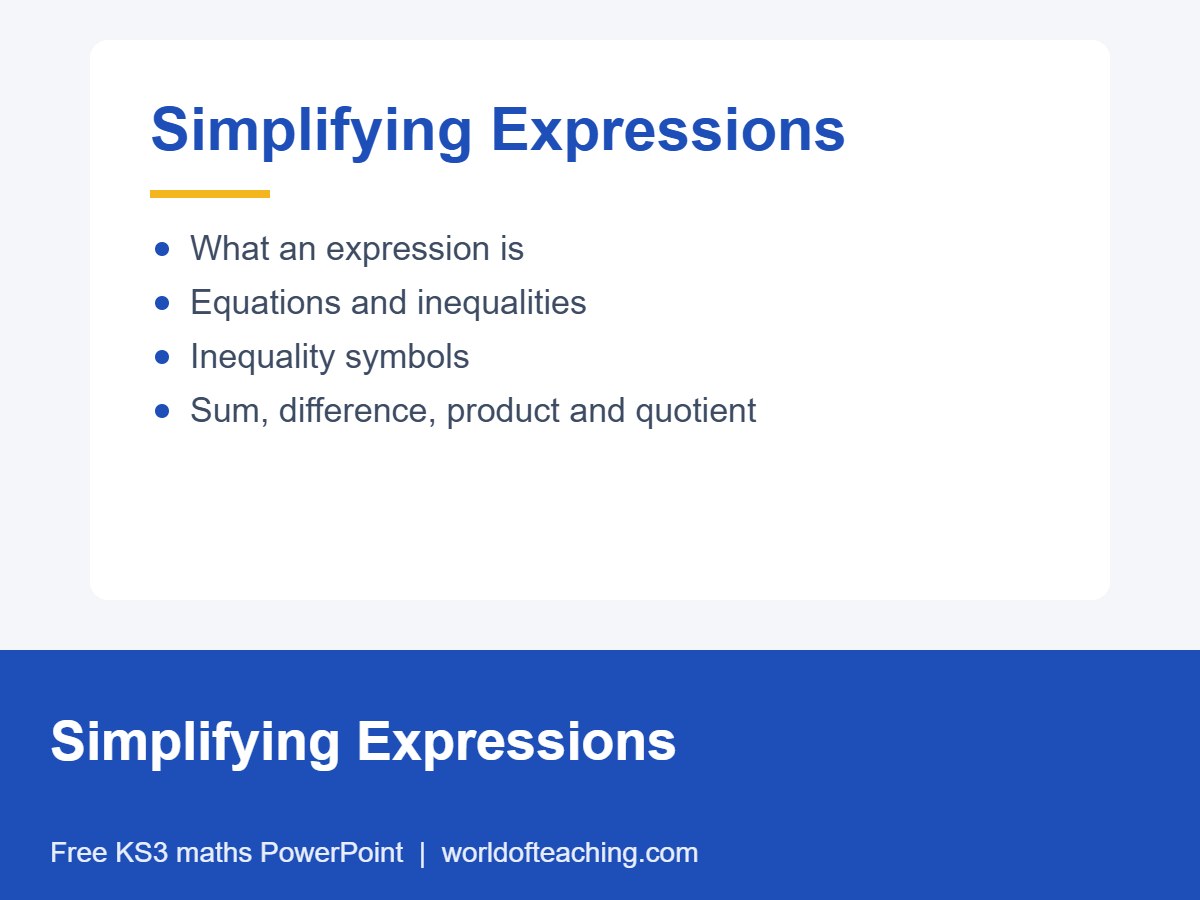
An introductory algebra lesson on expressions. It explains what expressions, equations and inequalities are, the meaning of sum, difference, product and quotient, powers, the main grouping symbols and the order of operations used to simplify an expression.
What this presentation covers
- what an expression is
- equations and inequalities
- inequality symbols
- sum, difference, product and quotient
- powers
- grouping symbols
- order of operations
Level: KS3
Slides: 11
Format: PowerPoint (.pptx)
Contributed by: Shane Fods
Teaching notes
How to use it. An 11 slide introductory algebra lesson for KS3 that builds the vocabulary pupils need before they start simplifying. It works well alongside a card sort where pupils match words such as sum, product and quotient to their symbols, and sort statements into expressions, equations and inequalities. Follow it with practice on collecting like terms, starting with simple examples such as 3a + 2b + 5a.
Key words
- Expression: a collection of terms with no equals sign, such as 3x + 2
- Equation: a statement that two expressions are equal, such as 3x + 2 = 11
- Term: a single number, letter or product of numbers and letters, such as 5x
- Like terms: terms with exactly the same letters and powers, such as 3x and 7x
- Simplify: make an expression shorter by collecting like terms
Quick check questions
- Simplify 4a + 3b + 2a.
- Is 2x + 5 = 9 an expression or an equation?
- Write an expression for the product of 6 and n.
Show answers
- 6a + 3b
- An equation, because it has an equals sign.
- 6n
Related lessons: Order of Operations | Linear Equations | Inequalities